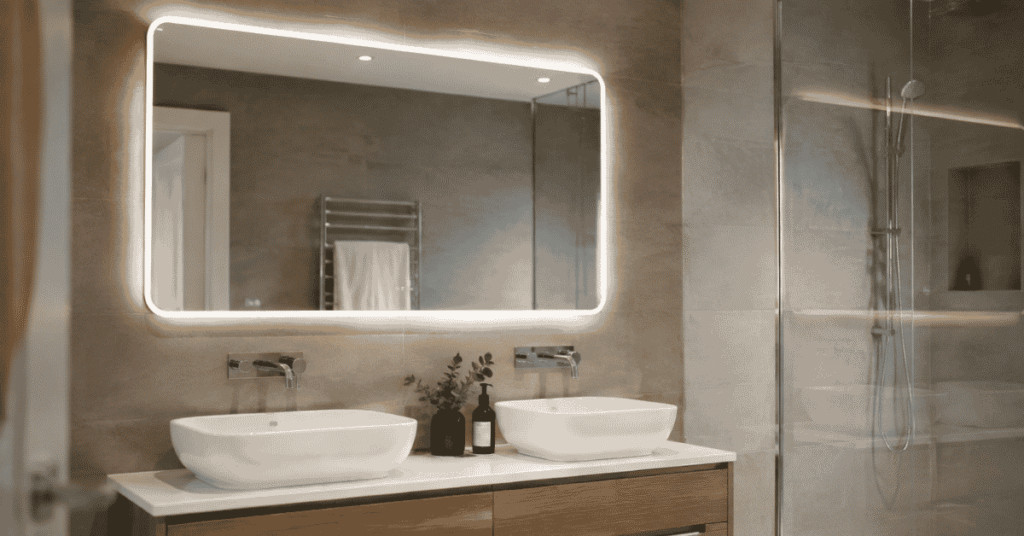
A bathroom mirror is often treated as the final cosmetic touch in a renovation, yet it dictates how functional the entire room feels every morning. Beyond helping you brush your teeth or shave, it controls light reflection across wall tiles and visually expands narrow layouts.
However, British bathrooms present punishing conditions. Daily condensation, cramped floor plans, and strict domestic electrical rules mean that decorative mirrors from living rooms quickly deteriorate.
Understanding vanity proportions, IP splash zones, and glass chemistry ensures you pick a mirror that endures heavy steam without tarnishing or causing electrical headaches.
Getting the Sizing and Scale Right
Visual balance comes down to how your mirror relates to the basin and vanity unit below it. A mirror that stretches beyond the furniture edges makes the basin feel miniature, while a postage-stamp mirror above an 800mm vanity leaves the wall looking empty.
Fitters and bathroom designers follow the 70% to 80% proportion guideline:
- Width Alignment: Choose a mirror whose width spans approximately two-thirds to four-fifths of your vanity unit. It should sit comfortably inside the vanity’s perimeter.
- Vertical Positioning: The centre of the glass should align with average standing eye level, typically 150cm to 160cm from the finished floor.
- Tap Clearance: Maintain at least 15cm to 20cm of clear wall space between the highest point of your basin tap spout and the bottom edge of the mirror. This prevents water droplets and limescale from building up along the lower rim. If you are fitting tall pillar taps or high-rise mixers, verify your dimensions alongside our mixer bath tap shower buying guide.
| Basin / Vanity Unit Width | Recommended Mirror Size | Ideal Layout |
|---|---|---|
| 400mm – 500mm (Cloakroom / Ensuite) | 350mm – 400mm | Slim vertical portrait or small round mirror |
| 600mm (Standard UK compact basin) | 450mm – 500mm | 500mm circular, soft arch, or 500x700mm rectangle |
| 800mm – 900mm (Family vanity) | 600mm – 700mm | 600x800mm illuminated portrait or double cabinet |
| 1200mm+ (Twin basin setup) | 1000mm single OR 2x 500mm | Wide landscape glass or matching twin mirrors |
Choosing Shapes to Counteract Rigid Tiles
Bathrooms are naturally dominated by hard, geometric lines: rectangular subway tiles, square shower screens, and boxy sanitaryware. The shape of your mirror can either reinforce that structure or soften it.
Circular and Oval Mirrors
Curved mirrors have surged in popularity because they break up the grid pattern of tiled walls. They introduce an organic focal point, particularly in compact ensuites where square lines feel clinical.
Arched Mirrors
An arched mirror provides the best of both worlds. The flat bottom edge aligns cleanly with horizontal splashbacks, while the rounded crown draws the eye upward, creating an illusion of higher ceilings.
Rectangular Mirrors
Rectangular glass remains the most practical option for daily grooming. Mounted vertically (portrait), it flatters tall spaces and captures your full upper torso. Mounted horizontally (landscape), it bounces daylight across dark windowless rooms, visually doubling the perceived room width.
Bathroom Electrics: Demystifying IP44 and Safety Zones
If you choose an illuminated bathroom mirror, mains power is essential. Battery-powered models save on wiring, but they deliver dim output and run through batteries quickly.
Under British Standard BS 7671 (IET Wiring Regulations), bathrooms are partitioned into specific safety zones according to water contact risk:
- Zone 0: The interior of the bath or shower tray. No mirrors belong here.
- Zone 1: The area directly over the bath or shower up to 2.25m from the floor.
- Zone 2: The zone extending 60cm around the basin taps and bath edges.
- Outside Zones: Any dry area positioned beyond Zone 2.
The Vital Safety Rule:
Because almost all mirrors hang directly over a basin or near a shower screen, they fall squarely within Zone 2. Any illuminated mirror or powered cabinet must carry an IP44 rating as an absolute minimum.
An IP44 certification confirms the internal circuitry is shielded against solid particles larger than 1mm and water sprays from any angle. In England and Wales, electrical work inside bathrooms must comply with Part P of the Building Regulations. Always have a registered domestic electrician run cables to an independent switched fused spur or connect into your lighting circuit.
Smart Features: Practical Upgrades vs Gimmicks
Modern illuminated mirrors offer an array of built-in tech. Here is how key features perform in daily life:
1. Heated Demister Pads
A heated demister pad is a thin electric heating film fitted to the rear of the glass. When activated, it warms the glass slightly above room temperature, preventing steam droplets from condensing. You can step out of a hot shower to a clear central reflection without wiping the surface with a towel and leaving smears.
Controlling moisture remains crucial for overall home health; explore our recommendations on how to stop condensation on bedroom windows overnight to manage broader household dampness.
2. Shaver and Toothbrush Sockets
UK building regulations ban conventional 13A three-pin household plug sockets in bathrooms. However, mirrors fitted with integrated dual-voltage shaver sockets (115V / 230V) use internal isolating transformers certified to BS EN 61558-2-5.
- They are designed specifically for low-draw devices: electric toothbrushes and shavers.
- Important Note: Never attempt to plug high-draw styling tools like hairdryers or straighteners into these sockets, as the thermal fuse will blow immediately.
3. Adjustable Colour Temperature (Kelvin)
Look for LED mirrors that let you toggle between warm white (approx. 3000K) and daylight white (approx. 4000K to 5000K). Warm white creates a tranquil ambience for an evening soak, whereas daylight white provides crisp, shadow-free clarity for morning grooming and skincare.
4. Infrared Sensors vs Touch Controls
Infrared wave sensors allow hands-free operation, keeping wet fingers off the glass.
- Crucial Fitting Tip: Maintain at least 150mm of clear space below the sensor. Placing an infrared sensor too close to a shelf or tall tap spout can trigger endless flickering.
Why Cheap Mirrors Turn Black at the Edges (Desilvering)
Many homeowners notice dark, cloudy patches creeping inward from the edges of an older bathroom mirror. This degradation is known as desilvering.
Traditional mirror manufacturing relies on a thin backing layer of aluminium or copper. When warm condensation and cleaning sprays penetrate unsealed glass edges, chemical reactions oxidise the metal backing, lifting it off the glass.
- Always insist on Copper-Free Silver Glass. This modern backing resists moisture oxidation and keeps the perimeter pristine.
- Select glass with a thickness of 4mm to 5mm with machine-polished edges. Budget 3mm glass is prone to subtle bowing, resulting in funhouse-mirror distortions.
- For homes with young children, verify the glass has safety film backing (BS EN 12600 standard). If an impact occurs, the safety layer holds the broken pieces together instead of spilling glass into the basin.
Flat Mirror vs Mirrored Cabinet: Choosing the Right Format
Where floor space is at a premium, storage decisions make or break bathroom tidiness.
- Choose a Flat Mirror if your bathroom already includes built-in vanity drawers or tallboy units, or if the basin sits in a narrow walkway where a deep cabinet might crowd your head.
- Choose a Mirrored Cabinet if you need to keep daily clutter—toothbrushes, medicines, and creams—off the basin ledge.
- Keep the cabinet depth strictly between 130mm and 150mm. Deep units cause you to bang your forehead when bending down to rinse your face.
- In compact cloakrooms, keeping visual lines streamlined is just as vital as choosing space-efficient fixtures—similar to the space principles in our square toilet seat buying tips for small bathrooms.
Wall Mounting and Tile Drilling Essentials
A heavy illuminated double cabinet can weigh between 12kg and 22kg before you add the weight of stored bottles. Fitting one securely requires proper anchorage.
1. Solid Masonry vs Stud Plasterboard Walls
- Solid Brick / Block Walls: Standard nylon wall plugs and heavy-duty zinc-coated screws hold the brackets safely.
- Plasterboard Stud Walls: Never rely on standard plastic rawl plugs; they tear straight through plasterboard under heavy shear loads. Locate the vertical timber studs with a stud finder and anchor at least one bracket screw into solid wood. Where studs do not align with your basin centre, use heavy-duty hollow wall anchors (such as GripIt or Geefix anchors) rated for 20kg+ loads.
2. Drilling Porcelain and Ceramic Tiles Without Cracking
Drilling into finished bathroom tiles causes anxiety for most DIYers. Follow these proven trade steps:
- Place criss-crossed masking tape over the drill mark to stop the drill bit from skidding across the glaze.
- Use a dedicated diamond-tipped or carbide spear drill bit.
- Turn off hammer action completely. Standard rotary drill mode is essential; hammer mode shatters tiles instantly.
- Keep the drill bit cool by dipping it into cold water every few seconds. Once you penetrate through the tile and hit masonry, switch back to a standard masonry bit.
3. Never Use Acidic Silicone
If you are gluing a frameless mirror directly to flat tiles, never use standard bathroom silicone or solvent grab adhesives. The acetic acid in regular silicone eats straight through the reflective backing within weeks. Use only a dedicated, solvent-free neutral-cure mirror adhesive.
Frequently Asked Questions
Can an LED bathroom mirror be wired to a standard wall switch?
Yes. An electrician can wire the mirror into your existing bathroom lighting circuit so the lights turn on with the main wall switch. Alternatively, they can route power through an independent switched fused spur outside the bathroom, allowing you to run the heated demister pad independently during daytime.
Do demister pads heat the whole mirror surface?
No. Demister pads generally cover the central 60% to 75% of the mirror glass. This ensures your primary viewing area stays clear while protecting edge seals from excessive heat and reducing electricity consumption.
Can you charge an electric toothbrush from a mirror shaver socket?
Yes. Mirror shaver sockets use isolating transformers (meeting BS EN 61558-2-5) designed for low-drain personal care devices, including Oral-B and Philips Sonicare chargers. They will not support high-wattage appliances like hair dryers.
How far above the basin should a bathroom mirror be hung?
A gap of 15cm to 20cm between the top of the basin tap and the bottom of the mirror is ideal. This allows comfortable access to tap levers while keeping splash marks off the glass.