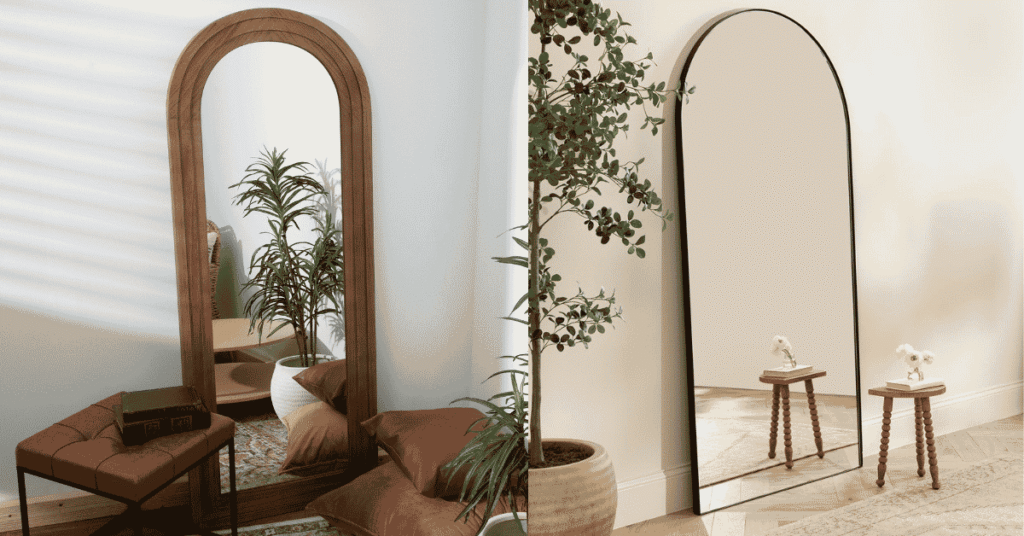
Hang an arch mirror in the right spot and it can genuinely change how a room feels brightening a gloomy corner, tricking a narrow hallway into feeling wider, or softening a space that’s otherwise all hard edges and straight lines. That’s exactly why they’ve become such a favourite in UK terraces, flats and compact new-builds, where every bit of visual breathing room counts.
Don’t reach for the drill straight away. Prop the mirror up in a few different spots first and actually look at what it’s reflecting. The right position isn’t just about the empty wall it’s about what the mirror throws back into the room.
Place an Arch Mirror Near Natural Light
If you want a quick win, put the mirror opposite or close to a window. It’ll bounce daylight deeper into the room, which makes a real difference in north-facing spaces or homes where the windows are on the small side.
That said, directly opposite isn’t always the answer. Catch the afternoon sun at the wrong angle and you’ll end up with glare bouncing off the TV, a laptop screen or a polished tabletop. Shift the mirror a little to one side and you usually get the brightness without the annoyance.
In a small sitting room, reflecting a window can also read as a second opening onto the world outside you get the sense of more space without moving a single piece of furniture.
Use a Black Arch Mirror in a Narrow Hallway
Hallways are where a black arch mirror really earns its keep. The dark frame gives the piece definition, while that curved top keeps things from feeling too stark or formal. Go tall and slim and you’ll pull the eye upward, which helps a cramped entrance feel less like a corridor.
Hang it above a shallow console table, a radiator cover or a shoe cabinet just leave a bit of breathing room between the furniture and the frame so the two feel like a set rather than a squeeze.
A full-length version near the front door earns its place too, doubling as your last check before you head out.
Make the Fireplace the Main Feature
In plenty of British living rooms, the wall above the fireplace is the focal point whether you like it or not. An arch mirror here softens a square mantel and adds something contemporary without erasing any period detail underneath.
Get the width right and it’ll relate to the mantelpiece properly go too narrow and it looks lost, too wide and it starts feeling top-heavy. Leaving a bit of visible wall on either side usually strikes the right balance.
And check what’s actually being reflected before you drill a single hole. A pendant light, a piece of art, some greenery or an interesting opposite wall will do far more for the room than a blank ceiling or a cluttered shelf staring back at you.
Style a Black Arch Mirror Above a Console
Pair a mirror with a console table and you’ve got an instant, polished arrangement works in an entrance, a dining room, or an open-plan space. The table anchors it visually, and the arch adds height above.
Keep the styling simple, because whatever you put on that console gets doubled in the glass. A lamp, a small plant, maybe a tray that’s usually plenty. Pile on more than that and the whole corner starts to look busy rather than curated.
Fancy something a bit less symmetrical? Hang the mirror slightly off-centre and balance it out with a tall lamp or a vase on the opposite side.
Lean an Arch Mirror in the Bedroom
There’s something more relaxed about a full-length mirror leaned against the wall rather than hung it gives the bedroom an easy, informal feel, and it’s just as useful for checking an outfit as anything mounted on a wardrobe door (arguably more forgiving to look at, too).
Try it beside the wardrobe, near the dressing table, or in a corner that’s otherwise doing nothing. In a smaller room, positioning it close to a window adds extra brightness as a bonus. Just steer clear of pointing it straight at the bed if reflections at night aren’t your thing.
One thing not to skip, even with a leaning mirror: anti-tip fixings. Non-negotiable if there are kids or pets in the house.
Add a Black Arch Mirror to the Dining Room
Dining rooms, especially the darker ones, benefit hugely from a black arch mirror. A side wall tends to work best here it reflects the table and the lighting without putting constant movement right in front of people trying to eat.
Aim it so it catches a pendant light, a sideboard display, or a table that’s actually been dressed nicely. Warm bulbs and candlelight look particularly good doubled in the glass, and they make the room feel deeper once the evening sets in.
The dark frame does double duty too, tying together black chair legs, cabinet handles or light fittings scattered around the room.
Choose the Right Bathroom Position
In a bathroom or downstairs cloakroom, an arch mirror takes the edge off all those straight lines tiles, cabinets, square fittings. Above the basin is the obvious spot, but measure twice here, because bathrooms are unforgiving of a mirror that’s slightly too wide.
As a rule, keep it no wider than the vanity or basin underneath. Leave clearance for taps, wall lights, shelves and sockets and if the ceiling’s low, go for a shorter design rather than forcing in something oversized.
Wall lights either side give you an even, flattering reflection for actually getting ready in the morning. A single fitting centred above the curve is a neat alternative if wall space is tight.
Create Contrast with a Black Arch Mirror
On a painted or panelled feature wall, a black frame can become the room’s main event. It sits particularly well against warm white, beige, muted blue, deep green or soft grey.
Centre it if the wall and furniture either side are symmetrical. On a wider wall, going off-centre often looks more natural and less like it was measured with a spirit level. A floor lamp, a chair or a tall plant nearby helps balance the composition.
Give that curved outline some space to actually stand out surround it with too many photos, prints or shelves and you dilute the whole effect.
Common Placement Mistakes
The mistake almost everyone makes: staring at the empty wall instead of imagining the reflection. Walk around the proposed spot and look at it from a few angles. Mirrors are just as happy doubling laundry piles and tangled cables as they are doubling nice light and greenery.
Height matters more than people expect, too aim for the centre to sit around eye level. Above a piece of furniture, the mirror should feel connected to it, not stranded halfway up the wall.
And don’t forget to check doors, cupboards and the paths people actually walk. The most beautiful placement in the world isn’t worth much if a door clips the frame every time someone opens it.
Pros and Cons
Pros
- Get the placement right and a dark or cramped room can genuinely feel brighter, taller and more open.
- The curved shape adds character on its own no need for an expensive renovation to get the effect.
Cons
- Get the placement wrong and you’re reflecting glare, clutter, or the least attractive corner of the room.
- Larger designs are heavy and need proper, secure fixings something to think about on older walls especially.
Final Thoughts
There’s no single “best” spot for an arch mirror it really comes down to your room’s light, its proportions, and what you actually need it to do. Use it to lift a dull view, strengthen an existing focal point, or make a practical corner work harder. Whatever you do, test a few positions before you commit to drilling; it’s the cheapest insurance against a mistake you’ll be staring at for years.
Dark frames bring a bit of confident contrast into a room, while timber, brass and paler finishes lean softer and more understated. Whichever style you land on, the placement should feel balanced — like the mirror was always meant to be there.
FAQs
Can I place a mirror directly opposite a window?
Yes, and it’s one of the easiest ways to spread daylight around a room. Just keep an eye on direct sunlight you may need to nudge the position slightly if it starts throwing glare.
Is a black arch mirror suitable for a small room?
Yes. The slim frame adds definition without eating into floor space, and the reflective surface still does the job of opening the room up visually.