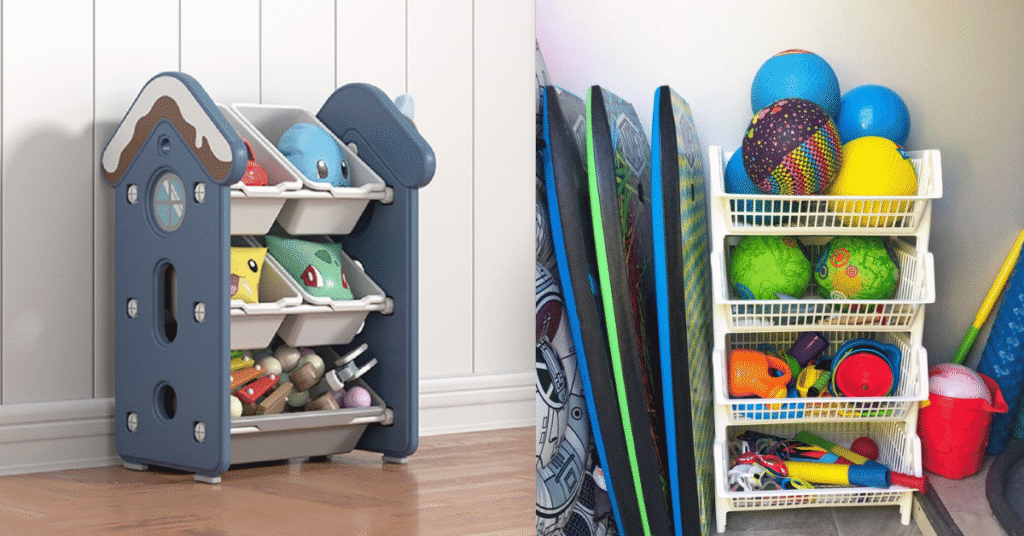
If you’ve got kids, you already know the drill. One minute the room’s tidy, the next it’s ankle-deep in building blocks, dolls, cars and soft toys you didn’t even know you owned. The real problem usually isn’t too many toys it’s not having a system that still works at 6pm, when dinner needs making, bedtime’s looming, and nobody’s got the energy left for a proper tidy-up. Good Kids Toy Storage should make clearing up faster, keep the everyday favourites within reach, and stop the family room slowly turning into a warehouse.
None of this has to be expensive or clever, either. In most UK homes, a handful of well-chosen pieces will beat a room stuffed with matching storage furniture every time.
Start With What Your Kids Actually Play With
Before buying anything, have a proper look at what needs storing. Big toys, puzzles, books, tiny craft bits they don’t behave the same way, so they shouldn’t all be treated the same way either.
Soft toys are happy in one big basket, no sorting needed. Building bricks want smaller containers or drawers so they don’t end up underfoot across the whole house. Board games stack fine on shelves. And whatever gets played with daily needs to sit low enough that kids can grab it without asking.
A workable Kids Toy Storage setup usually splits into two rough tiers everyday toys stay visible and within reach, while the occasional stuff goes higher up or gets tucked into a cupboard.
One thing worth avoiding: don’t invent a separate category for every single toy type. If tidying up takes more thought than the playing did, it just won’t get done.
The Kids Toy Box: Old-Fashioned, But Still Worth It?
There’s a reason the kids toy box has never really gone away it’s dead simple. Lift the lid, toys go in, lid comes back down. When you’re running on empty by 7pm, that kind of simplicity beats any clever system going.
It’s especially good for bulky items rain sets, dolls, dressing-up clothes, oversized vehicles, that sort of thing. A wooden chest also tends to look more at home in a living room than a stack of bright plastic tubs ever will.
Safety’s worth thinking through properly, though. If you’re buying a lidded kids toy box, look for a soft-close hinge, decent lid support, and finger gaps. A heavy lid that can slam down on its own has no business being near young children full stop.
There is a downside: deep boxes get messy fast. Small pieces sink to the bottom and disappear for weeks, so it’s worth dropping a couple of lightweight baskets inside so things don’t turn into a black hole.
Open Shelves for the Stuff They Reach for Daily
Open shelving earns its keep when kids need to actually see what they’ve got. Toys shut away behind cupboard doors get forgotten within a fortnight, whereas shelves let a child pick one thing to play with instead of tipping out every box hunting for it.
Baskets or fabric cubes stop open shelves looking like chaos one for cars, one for animals, one for whatever the craft drawer has turned into.
This kind of Kids Toy Storage also has the advantage of growing with your child. Years later, that same shelving unit is just as happy holding books, school supplies, or board games instead.
Keep anything heavy on the lower shelves. Anything fragile, or unsuitable for a nosy younger sibling, belongs up out of reach.
Don’t Overlook the Space Under the Bed
Floor space is precious in most UK bedrooms, and the space under the bed is usually big enough for puzzles, seasonal toys, or anything that doesn’t need to be out every day.
Low boxes on wheels work well since kids can pull them out unaided. Clear containers mean everyone can see what’s inside without opening it first, and even picture labels keep things looking a bit tidier than they’d otherwise be.
A shallow kids toy box built for under-bed use suits Lego, train tracks, or art supplies nicely. Just don’t cram in every last centimetre kids still need enough room to pull the thing out without wrestling it free.
Pick a System Kids Can Actually Keep Up With
Parents love designing beautifully organised systems no child could ever maintain. Ask a four-year-old to sort toys into twelve precise categories and that system survives, generously, about one play session.
Keep it broad. Cars together. Dolls together. Art stuff together. Honestly, that’s most of it.
Picture labels work well before kids can read; simple written ones take over once they can, and tend to help them start taking a bit of ownership over their own things.
The most useful Kids Toy Storage resets in five or ten minutes, not thirty. If it’s eating half an hour every evening, something in the system needs simplifying.
Shared Family Rooms Need Baskets, Not Chaos
Not every toy has to live in a bedroom. Plenty of families end up with toys scattered through the lounge, the dining area, even the kitchen wherever people actually spend their time.
A big woven basket handles soft toys nicely without turning the lounge into a nursery. Lidded baskets hide clutter completely; open ones make the quick, five-minute tidy-ups a bit easier.
If a kids toy box is going in a shared room, go for a finish that actually fits the rest of the furniture. Neutral tones and simple wooden designs tend to sit next to sofas and bookcases without sticking out like a sore thumb.
Sometimes Less Is More Try Rotating Toys
The simplest fix for a cluttered system is often just reducing what’s out at any one time.
Pack a chunk of toys away for a few weeks and leave fewer options visible. Kids often play more intentionally and for longer when they’re not drowning in choices.
Rotation also takes pressure off your Kids Toy Storage generally. Rather than cramming everything into one room, keep part of the collection in a cupboard, the loft, or another dry spot out of the way.
And when the toys eventually come back out, half-forgotten favourites suddenly feel new again which, frankly, is a nice trick for free.
Kids Toy Box: The Honest Pros and Cons
A kids toy box solves a surprising amount of everyday clutter, but it’s worth weighing up both sides before buying one.
Pros:
- Tidying takes seconds toys go straight in, no sorting required.
- Great for bulky items that never sit neatly on a shelf anyway.
Cons:
- Small pieces sink and vanish at the bottom.
- A badly designed lid can be a genuine finger-trapping hazard.
For most families, a mix works best one large chest for the awkward, bulky stuff, plus smaller baskets and shelves for whatever benefits from being properly sorted.
Don’t Let Storage Become Its Own Kind of Clutter
Buying a lot of storage furniture can quietly create a new problem. A bedroom stacked with boxes, drawers and shelving might technically be “organised” and still feel completely crowded.
Measure before buying anything door swing, radiators, how much space a drawer actually needs to open all the way.
In smaller rooms, going vertical with shelving buys more capacity without eating into floor space. Multipurpose furniture helps too: some benches hide storage under the seat, and cabin beds often come with drawers built in underneath, which is space you’d otherwise waste entirely.
A good Kids Toy Storage plan should free up usable space, not just give you more places to shove things out of sight.
Fold Tidying Into the Daily Routine
Kids help far more willingly when tidying feels like a normal, predictable part of the day rather than a punishment tacked onto the end of it.
A five-minute reset before bedtime usually does the job books back on the shelf, loose pieces back in their box, floor cleared.
Give younger kids one specific job rather than a vague “tidy everything.” They collect the cars, you handle the puzzle pieces. Everyone finishes at roughly the same time.
Keep the kids toy box somewhere easy to reach so they can put the bigger stuff away themselves. Small touches like this make the whole thing feel like part of everyday family life, not another chore bolted onto an already long day.
Build a System That Grows With Them
Kids’ interests shift fast this year’s dinosaur obsession could easily be next year’s football kit, craft supplies, or a stack of school books.
That’s part of why adaptable furniture wins long-term. Neutral shelving, sturdy baskets, and a simple kids toy box can all stay useful for years, long after the toys inside have changed completely.
Storage doesn’t need to look picture-perfect around the clock. It just needs to make life a bit easier — kids can find their favourite things, put most of it away themselves, and you get a floor you can actually walk across without finding a stray Lego brick with your foot.
That, really, is what good Kids Toy Storage comes down to.





1 thought on “Kids Toy Storage: Best Solutions for Busy Families”
Comments are closed.