Regulated manufacturing environments put unusual demands on IT hardware, and few product categories illustrate this better than cleanroom computers and HMIs. A standard industrial PC might survive dust, vibration, and temperature swings on a general factory floor without much trouble, yet fail completely in a pharmaceutical cleanroom, where the real threat is not physical damage but contamination risk from surfaces that cannot be fully disinfected between shifts.
That distinction shapes almost every purchasing decision in regulated manufacturing, whether the buyer is a validation engineer, a plant manager, or someone in procurement trying to reconcile budget with compliance requirements. It is not enough for hardware to work reliably in the mechanical sense. It has to be verifiably clean, auditable, and built in a way that inspectors from the FDA or an EU GMP authority can sign off on without hesitation during a facility walkthrough. Getting this wrong does not just create maintenance headaches down the line, it can hold up an entire production line during an audit, sometimes for weeks, while corrective actions are documented and implemented.
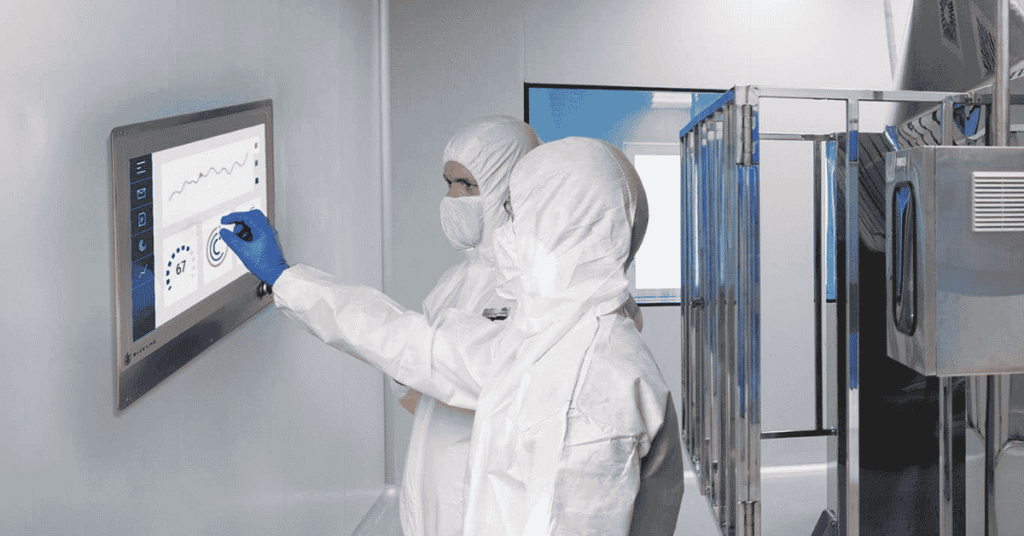
Fixed HMIs and panel PCs sit at the center of this challenge because they are touched constantly throughout a shift. Operators interact with them dozens of times a day, often while wearing multiple layers of gloves, and the interface has to remain responsive and legible under those conditions without ever becoming a contamination point itself. A device that looks identical to a standard industrial panel PC on the outside can behave very differently once it has gone through hundreds of cleaning cycles with aggressive disinfectants, which is exactly why regulated manufacturers tend to specify hardware by construction standard rather than by general industrial rating alone.
Reliability expectations also differ substantially from general industrial settings. Many regulated production lines run continuously, which means unplanned downtime on a fixed HMI is not simply an inconvenience, it can halt an entire batch mid-process and trigger a costly investigation into whether the batch itself remains compliant.
Why construction details decide compliance outcomes
The construction of the hardware itself is where compliance is genuinely won or lost, and it is worth being specific about why. Stainless steel housing in grades such as AISI 304 or 316L, smooth sides, and rounded edges are not aesthetic choices made for a clean product photo. They exist because seams and crevices are exactly where residue and microbial growth accumulate over repeated use, and eliminating them is what allows equipment to withstand repeated cleaning with aggressive agents like VHP, Spor-Klenz, or isopropyl alcohol without degrading or developing weak points over years of service.
Blue Line’s product line in this category reflects that thinking directly, with its cleanroom computers and HMIs engineered after what the company describes as the strictest interpretation of the EU GMP classification covering cleanroom grades A through D. That is a meaningfully higher bar than general industrial IT hardware is designed to meet, and it is the kind of detail that procurement teams in pharma and biotech tend to scrutinize closely before approving a new supplier for a validated production environment, since switching hardware mid-project is expensive and disruptive.
Touch technology matters just as much as the housing material. Glove compatibility is not a nice-to-have feature in this context, it is often a hard operational requirement, since operators frequently work through two or three layers of nitrile or neoprene gloves depending on the cleanroom grade they are assigned to. A touchscreen that requires bare skin contact, or that misreads input through multiple glove layers, quietly undermines the entire point of installing an HMI in the first place, forcing workarounds that compliance teams generally do not want to see happening on their production floor.
Fanless, passively cooled designs round out this picture, since any moving air inside a sealed cleanroom device raises questions about particle circulation that most facilities would rather avoid answering during an inspection.
Planning IT infrastructure around long equipment lifecycles
Regulated manufacturers rarely replace production IT hardware on the same cycle as consumer electronics, and this changes the calculus around almost every hardware decision made at the design stage of a facility. A cleanroom computer installed today may still be running the exact same validated software configuration a decade from now, because requalifying a new device against existing GMP documentation is a significant undertaking involving multiple departments, extensive testing, and considerable cost.
That reality pushes buyers toward hardware with a genuinely long product life cycle and predictable spare parts availability, rather than the fastest processor or the newest interface on the market. A device that gets discontinued after two years creates a real problem for a facility that expects to run it for ten, since sourcing replacement units or spare components eventually becomes difficult or impossible.
Mounting flexibility also matters considerably at this stage of planning, since equipment installed for wall, pipe, or panel mounting today needs to remain serviceable and reconfigurable as production lines evolve over the years ahead. Facilities that choose hardware with a wide range of mounting options tend to have an easier time adapting to layout changes without triggering a full requalification process each time a line gets reorganized.
Ultimately, the industrial IT choices made at the design stage of a regulated facility tend to constrain or enable everything that follows, from routine maintenance windows and spare parts budgeting to how quickly a line can be reconfigured for a new product without disrupting ongoing compliance status.