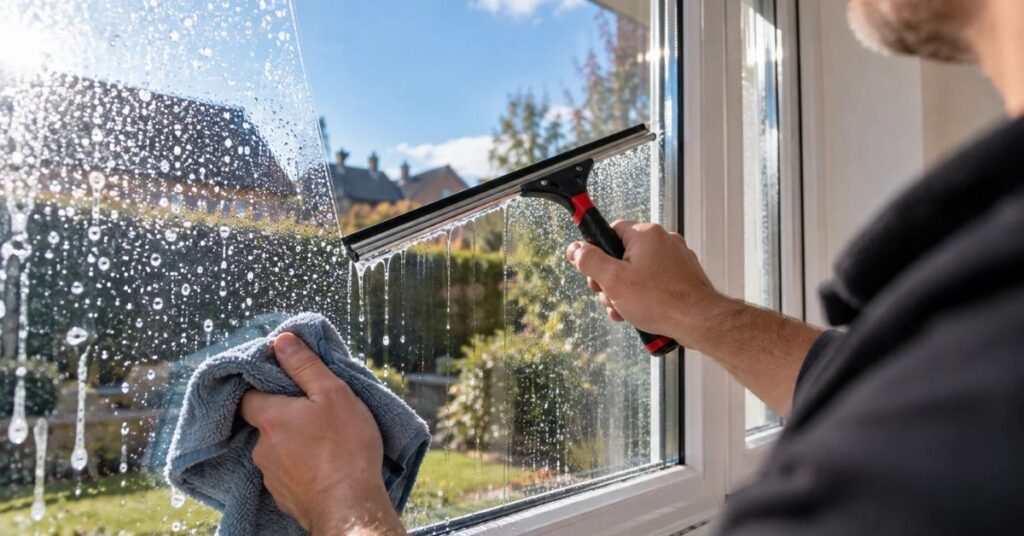
Streaks on a window nearly always come from the same four things: dirty water drying on the glass, too much cleaning product, a cloth that is already grubby, or cleaning in direct sun. Fix those and ordinary tap water with a little washing-up liquid is enough. This guide covers the best way to clean windows in a UK home, inside and out, including how to reach high glass with a pole.
What Is the Best Way to Clean Windows?
The best way to clean windows without streaks is to wash the glass with warm, lightly soapy water, take the water off with a squeegee, and dry the edges with a clean microfibre cloth. Do the frames first, work from the top of the pane to the bottom, and pick a dull, dry day rather than a sunny one.
The squeegee does most of the work. It removes the dirty water before it dries, so nothing is left on the glass to mark it. A cloth on its own pushes the water around and can leave lint behind.
Whether you are asking what is the best way to clean windows, whats the best way to clean windows in a small flat, or what’s the best way to clean windows on a whole house, the method stays the same. Only the tools change.
Window cleaning methods compared
| Method | Best for | Limits |
|---|---|---|
| Soapy water and squeegee | Whole-house cleans, inside and out | Needs a little practice to get even strokes |
| Spray and microfibre cloth | Quick touch-ups indoors | Smears on very dirty glass |
| Window vacuum | Inside glass and condensation | Costs from about £30 to over £100 and needs charging |
| Pole with brush and squeegee | High windows and conservatories | Less control than working by hand |
| Water-fed pole with purified water | Outside glass, no ladder | Needs special kit and a water supply |
Why Windows Streak
Knowing the cause makes it easier to avoid.
- Hard water. Tap water in much of the UK contains calcium and other minerals. When it dries on glass it leaves a faint haze and small spots.
- Too much detergent. Excess suds dry into a film. A teaspoon of washing-up liquid in a bucket of warm water is plenty.
- Sun and heat. The solution dries before you can remove it, which leaves lines.
- Dirty cloths and blades. Old grime gets dragged across clean glass.
- Pollen and traffic film. In towns and in spring, a greasy layer builds up that plain water does not shift.
- Wrong order. Washing the glass before the frames lets dirty drips run over finished panes.
What You Need
- A bucket and warm water
- Washing-up liquid
- A squeegee with an undamaged rubber blade
- Two or three microfibre cloths
- A soft sponge or scrubber
- A window cleaning brush for frames and corners
- An old towel for the sill
- A spray bottle, if you prefer a spray method
Squeegee
A squeegee between 25 and 35 cm wide suits most domestic windows. Run a finger along the blade. If it feels nicked or rounded, replace it, because a damaged edge leaves a line on every pass.
Best Cloth for Cleaning Windows
The best cloth for cleaning windows is a clean, lint-free microfibre cloth kept only for glass. Wash it on its own and skip fabric softener, which coats the fibres and leaves greasy smears. A waffle-weave glass cloth also works for the final polish.
Kitchen roll and old tea towels shed fibres. A cloth that has been used on kitchen surfaces carries grease. Once a cloth feels damp through, swap it for a dry one. As a rough guide, one cloth manages six to eight windows.
Window Cleaning Brush and Brush for Washing Windows
A window cleaning brush reaches tracks, seals and corners that a sponge misses. When choosing a brush for washing windows, look for soft bristles that will not scratch the glass or mark the frame. A short hand brush is fine indoors. Outside, a brush that fits on a pole saves a lot of effort.
Cleaning Solutions
Washing-up liquid and warm water. Cheap, gentle and suitable for almost every window.
White vinegar and water. Dilute it, for example one part vinegar to four parts water. Neat vinegar is acidic and can damage frames and rubber seals.
Shop-bought glass cleaner. Handy for quick jobs. If you refill a spray bottle, use a clean glass cleaner bottle that has never held anything else, because old residue causes smears.
Purified water. Water without minerals dries without spots. Professionals use it for this reason, and it helps if your tap water is hard.
Making Your Own Window Cleaning Solution
Two home mixes cover almost every job.
Soapy water. Add one teaspoon of washing-up liquid to a bucket of warm water, about five litres. Stir gently so it does not foam. If a thick layer of suds forms, tip some out and top up with plain water. Suds that dry on the glass are one of the main causes of streaks.
Vinegar spray. Mix one part white vinegar with four parts warm water in a clean spray bottle and label it. Spray a light layer on the glass, leave it for about 30 seconds, then wipe or squeegee. It cuts light grease and mild limescale. You do not need it for every clean, and it should not sit on frames, rubber seals or natural stone sills.
Rinse water. In hard water areas, keep a second bucket or spray bottle of filtered or purified water for a final rinse. It costs very little and reduces the spotting that tap water leaves behind.
When to Clean: Timing Around UK Weather
The best way to clean windows UK weather permitting is on a dry, overcast day. Direct sun dries the solution too fast and the glare hides missed spots. Rain washes dirty water back onto the pane. In winter, avoid days at or below freezing, because water can freeze on the glass.
Spring and autumn usually give the most reliable conditions. In summer, work early in the morning or in the evening when the glass is cool.
How to Clean Windows Inside
This is the best way to clean windows inside the house, and it suits most rooms.
1. Clear the area
Move curtains and blinds well away. Lay an old towel along the sill. Brush or vacuum cobwebs and dust from the frame and corners first, because dust turns to mud as soon as it gets wet.
2. Clean the frames
Wipe frames and sills with a damp sponge and a little washing-up liquid, then dry them. Keep cloths wrung out, since too much water around timber frames can lead to damp and mould over time.
3. Wash the glass
When cleaning inside windows, use less liquid than you think you need. Apply soapy water with a damp sponge or microfibre applicator, or mist a light layer of spray directly on the glass.
4. Remove the water
Start at the top corner. Pull the squeegee down in straight, slightly overlapping strokes and wipe the blade on a cloth after each pass. If you are using a cloth instead, wipe in an S-shape from top to bottom.
5. Dry the edges
Finish with a dry microfibre cloth along the edges and the sill. Check the glass from the side as well as head-on, because streaks show best at an angle.
Windows with condensation
In colder months, inside glass often runs with water in the morning. Take the water off with a squeegee or a window vacuum rather than a cloth, because a cloth only pushes it into the frame and the seals. Wet seals are where black mould starts, so dry them as well.
If condensation comes back every day, the cause is usually moisture in the room. For a full routine, see our guide on how to stop condensation on bedroom windows overnight. Open a window briefly after showers and cooking, keep furniture clear of the glass, and consider a dehumidifier in rooms that stay damp.
Best Way to Clean Windows Outside
Outside glass is dirtier, so it needs more water and a little more care. The best way to clean windows outside follows the same order as indoors.
- Remove loose dirt. Brush off cobwebs, bird mess and grit. If you find a large spider, check what a false widow spider looks like before you handle it.Rubbing grit across glass can scratch it.
- Wash the frames. Use warm soapy water and a soft sponge or brush.
- Wash the glass from the top down. Use plenty of solution and a window cleaning brush or sponge.
- Squeegee. Some people first “cut in” a dry edge by running the squeegee down one side. This gives each later stroke a dry starting line.
- Dry the sill and frame edges. Wipe them so water does not stain the wall below.
Squeegee technique in detail
Most streaks come from how the squeegee is used, so it is worth learning the movement.
- Wet the whole pane first so the blade glides instead of dragging.
- Start at the top corner and hold the blade at a slight angle, so only the rubber edge touches the glass.
- On small and medium panes, pull straight down in overlapping vertical strokes, each overlapping the last by a few centimetres.
- On wide panes, work in an S-shape from the top to the bottom, keeping the blade moving without stopping.
- Wipe the blade with a dry cloth after every stroke. This is the step most people skip.
- At the bottom, lift the blade off the glass and dry the lower edge and sill with a cloth.
If you see a line in the middle of the pane, go back over that area with a clean, dry blade rather than a cloth.
Cleaning Windows with a Pole
Upstairs windows, stairwell glass and conservatory roofs are hard to reach safely from a ladder. Cleaning windows with a pole lets you stay on the ground.
Choosing a pole
A telescopic window cleaning pole extends to the length you need and takes a brush, sponge or squeegee head. A good window cleaner pole is light and has a twist lock that holds. Basic kits with a squeegee start at around £30, and larger kits with a longer pole cost several times that.
- Window cleaning extension pole. Fits several heads and covers most two-storey homes.
- Long window cleaning pole. Suits tall glazing, extensions and conservatories.
- Long window washing pole with a water-fed brush. Water runs through the brush, so you wash and rinse in one pass. It works best with purified water, which dries without leaving spots.
Attachments worth buying
A brush or sponge head for washing, a squeegee head for drying, and a cobweb duster for corners and eaves cover most jobs. Buy a spare squeegee rubber at the same time, because a worn blade is the usual reason a pole clean leaves lines. Poles that take standard threaded heads let you swap or replace parts later without buying a whole new kit.
Using a pole safely
- Check that nothing touches overhead cables before you raise the pole.
- Look at the pane and frame first. Loose or cracked parts can fall.
- Wash from top to bottom with the brush or sponge head.
- Swap to the squeegee head and pull down in straight strokes.
- Keep the pole close to your body and rest when your arms tire.
If the glass is still out of reach, a professional window cleaner is the safer choice.
Ladder Safety
Ladders are meant for short, low-risk jobs, so use one only for windows you can reach comfortably. If you do, follow these rules:
- Stand it on firm, level ground, at an angle of about 1 in 4 (one unit out for every four up).
- Ask someone to foot the ladder while you climb.
- Keep three points of contact. Do not carry a bucket in your hand. Hang it from a hook or use a pole instead.
- Keep your belt buckle between the rails and never lean sideways to reach across.
- Do not use a ladder in wet, icy or windy weather.
For anything above first-floor height, use a pole from the ground or hire a professional.
Best Way to Wash Windows with uPVC, Timber or Aluminium Frames
The best way to wash windows depends partly on the frame, because some finishes are easier to mark than the glass.
- uPVC. Warm water and washing-up liquid is usually enough. Be careful with decorative finishes such as woodgrain or coloured foils, as harsh cleaners can damage the surface. White uPVC that has yellowed can be brightened with a cream cleaner.
- Timber. Use a damp cloth, not a wet one, and dry the frame afterwards.
- Aluminium. Mild soapy water works. Avoid abrasive pads that scratch the coating.
Bleach and abrasive cleaners can harm frames and seals. They are best avoided on every type.
Cleaning Sills, Tracks and Seals
Dirt that collects in the track and on the rubber seals turns to grey sludge every time you wash the glass, so clear it first.
- Vacuum or brush loose dirt and dead insects out of the track and the sill.
- Use an old toothbrush or a cotton bud to clean corners.
- Check the small drainage holes at the bottom of the outer frame. Clear them with a cocktail stick or a thin strip of plastic so rainwater can drain out.
- Wipe rubber seals with soapy water and dry them. Seals that stay damp are where mould starts.
Do this every few cleans rather than every time.
Best Way to Clean Glass
The best way to clean glass that is not a standard window depends on how dirty it is.
- Mirrors and shower screens. A light spray and a dry microfibre cloth is usually enough. If you are choosing a new one, our bathroom mirror buying guide covers sizing and fitting.
- Patio doors and bifold doors. Treat them like outside windows: wash, squeegee, dry the edges.
- Conservatory glass. Use a pole, and clean the roof on a cloudy day to avoid fast drying.
- Self-cleaning glass. Check the manufacturer’s instructions first, as some advise against abrasive cleaners.
For day-to-day cleaning glass in a kitchen or hallway, a damp cloth followed by a dry one removes most fingerprints.
Removing Stubborn Marks
| Mark | What works | Avoid |
|---|---|---|
| Limescale and hard water spots | Weak vinegar and water, left briefly, then wiped and dried | Neat vinegar on frames or seals |
| Bird droppings | Soften with warm water, then wipe | Scrubbing while dry |
| Paint flecks and sticky residue | A mild solvent such as methylated spirit on glass only | Getting solvent on seals or frames |
| Light mould on seals | Soft brush and mild soapy water, then dry well | Bleach |
Common Mistakes
- Using too much washing-up liquid
- Cleaning in direct sun
- Washing the glass before the frames
- Reusing a dirty cloth, or a squeegee blade that is nicked
- Using fabric softener on microfibre cloths
- Skipping the dry brush, so dust turns to mud
Troubleshooting Streaks
If the window still looks wrong when it dries, the pattern of the marks usually points to the cause.
| What you see | Likely cause | Fix |
|---|---|---|
| Long vertical lines | Dirty or nicked squeegee blade | Wipe the blade every stroke, or replace it |
| Hazy film across the pane | Too much detergent left on the glass | Rinse with clean water, then squeegee and polish |
| Small white spots | Hard water minerals | Wipe with weak vinegar and water, dry, and use purified water next time |
| Lint specks | Kitchen roll or a shedding cloth | Switch to a lint-free microfibre cloth |
| Smears only at the edges | Drips from the frame | Dry the frame and edges last |
| Streaks that only show in sunlight | A thin film of product | Repeat with less solution and buff with a dry cloth |
Do Newspaper and Cold Tea Work?
Newspaper is lint-free and can polish glass, but some inks leave black smudges, and a microfibre cloth is more reliable. Cold black tea on kitchen towel can clean a small pane or mirror, but it is slow for a whole house. Diluted vinegar works, though it is no better than soapy water for most jobs. These are fine for one or two windows. For everything else, a squeegee is faster.
Pros and Cons
Squeegee and Soapy Water
Pros
- Low cost, using items most homes already own.
- The clearest finish with no lint.
Cons
- It takes a little practice to get smooth, overlapping strokes.
- Edges drip if you rush, so they need drying.
Using a Pole
Pros
- Reaches high windows without a ladder.
- Handy for conservatories and extensions.
Cons
- Less control than working by hand.
- Longer poles cost more and take space to store.
How Often to Clean
Most homes do well with an outside clean every one to two months and an inside clean when the glass looks smeared. Homes near busy roads, trees or the coast may need it more often. A regular clean is quicker than a deep clean because the dirt has not had time to bond to the glass.
Seasonal guide for UK homes
- Spring. Pollen leaves a sticky film on outside glass. A full clean after winter works well now.
- Summer. Work early in the morning or in the evening, because heat dries the solution too fast. Watch for insects and bird mess.
- Autumn. Leaves, rain and damp mean outside glass gets dirty again quickly. It is also a good time to clean seals before condensation starts.
- Winter. Keep to inside glass on cold days. Clean outside only when the temperature is above freezing, and deal with condensation as it appears.
When to Hire a Professional
Call a local window cleaner if the glass is above first-floor level, hard to reach from the ground, or covered in heavy build-up. Many offer a regular round, and the price is often lower than buying a long pole kit for a few windows a year.
FAQs
What is the best way to clean windows without streaks?
Wash with warm soapy water, remove the water with a squeegee from top to bottom, and dry the edges with a clean microfibre cloth. Choose a cloudy day and use very little detergent.
Is vinegar good for cleaning windows?
Diluted white vinegar works on glass. Do not use it neat, and dry frames afterwards because the acid can damage them.
What is the best cloth for cleaning windows?
A clean, lint-free microfibre cloth. Wash it without fabric softener.
Can I use newspaper on windows?
You can, but some inks smudge. A microfibre cloth is more reliable.
How do I clean high windows without a ladder?
Use a telescopic window cleaning pole with a brush and a squeegee head. Check for overhead cables first.
Why do my windows still streak after cleaning?
The most common causes are too much detergent, a dirty cloth or blade, cleaning in sun, or hard water. Try less soap, fresh cloths, a cloudy day and purified water for the final wipe.
How often should I clean my windows?
Outside every one to two months, and inside whenever they look smeared.






1 thought on “Best Way to Clean Windows Without Streaks: UK Home Guide”
Comments are closed.