The Cotswolds Guide: Villages, Pubs, Rail Routes and Walking Trails
The cotswolds covers nearly 800 square miles of limestone hills, beech woods and golden stone villages across central southern England. It is the largest protected landscape in England and Wales.
Getting around takes planning. Public transport is sparse away from the main train lines. Popular villages pack out by 10am on summer weekends. Here is how to navigate the region, catch the right trains, pick the best villages and find pubs that still feel local.
Where is the Cotswolds and What Defines the Region?
If you want to know where is the cotswolds, look roughly 80 miles west of London. The region spans six counties: Gloucestershire, Oxfordshire, Warwickshire, Wiltshire, Worcestershire and Bath and North East Somerset. Gloucestershire holds the lion’s share, including the steep western hills overlooking the Severn Valley.
The stone under your feet dictates everything here. Millions of years ago, warm Jurassic seas left thick layers of oolitic limestone full of tiny fossils. Quarries at Guiting and Painswick produced the stone that built every cottage, barn and church. In the north around Chipping Campden, the stone glows honey-gold. Down south near Bath, it fades to a pale silver-grey.
In the Middle Ages, millions of native Cotswold Lion sheep grazed these wolds. Raw wool made this region the wealthiest corner of England. Wool merchants spent their profits building massive parish churches known as wool churches. They built stone manor houses and high street market halls that stand virtually unchanged today.
London to Cotswolds: Rail Connections and Transit Advice
You can travel from london to cotswolds by train without touching a car. Great Western Railway runs direct trains from London Paddington along two main routes.
The Cotswold Line
The northern line heads through Oxford straight into Gloucestershire.
- Moreton-in-Marsh: The main rail hub in the north. Direct services on the london to cotswolds train take 1 hour 35 minutes from London Paddington. Catch the Pulhams 801 bus from outside the station to reach Stow-on-the-Wold and Bourton-on-the-Water.
- Kingham: The stop for Daylesford Organic Farm and food-focused village pubs in Churchill and Bledington.
- Charlbury: Drops you close to the ancient Wychwood Forest and the Cornbury Estate.
The Golden Valley Line
If you want the southern valleys, take the train towards Cheltenham:
- Kemble: The stop for Cirencester, five miles down the road.
- Stroud: Drops you right into the steep Five Valleys, famous for farmers’ markets and common land walks.
- Cheltenham Spa: Good for reaching the northern ridge and Sudeley Castle.
Keep one rule in mind: rural buses in this part of England rarely run on Sundays. If you travel on the weekend, plan your rail connections and local taxi bookings ahead of time.
Prettiest Cotswold Villages and Quiet Hamlets
Deciding where to go in the cotswolds means choosing between famous river stops and quiet hill hamlets. Touring the cotswolds villages shows two very different sides to the region: busy tourist hubs and quiet farming hamlets.
Castle Combe
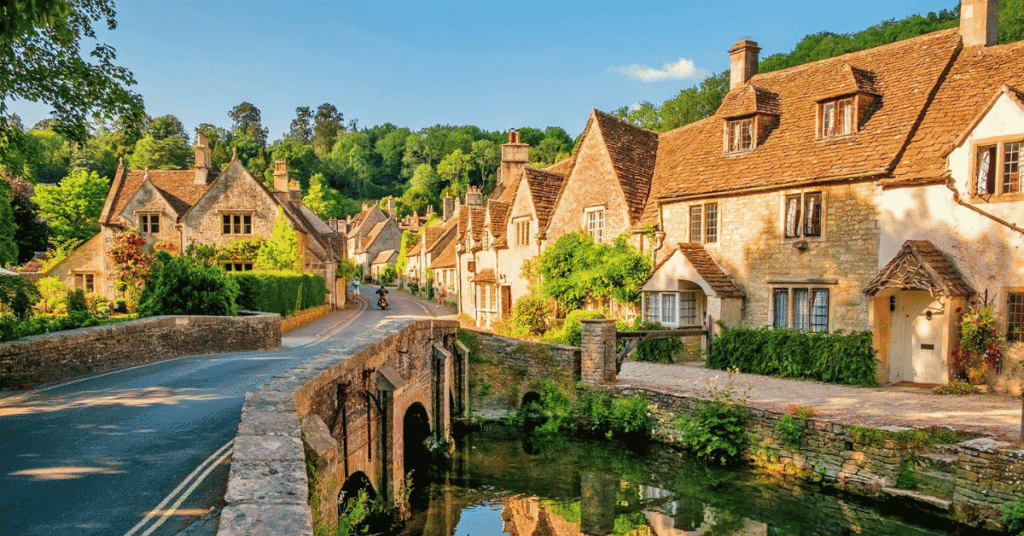
Castle Combe sits in Wiltshire’s Bybrook Valley and frequently tops lists of the prettiest cotswold villages. The village banned street lights and overhead cables decades ago. As a result, film crews use it for period dramas. Walk across the stone bridge over the Bybrook stream to see rows of 17th-century weavers’ cottages built from rough limestone rubble.
Bibury and Arlington Row
Bibury sits on the River Coln. Its main draw is Arlington Row, originally built in 1380 as a monastic wool store before weavers converted it into cottages in the 1600s. The National Trust looks after the row today. A clear chalk stream runs alongside the road, home to brown trout and water voles.
Upper and Lower Slaughter
If you want nice cotswold villages without coach parties blocking the road, head for Upper and Lower Slaughter. A flat one-mile footpath along the River Eye links the two. You get stone footbridges, a working 19th-century water mill and old manor houses tucked behind dry-stone walls.
Snowshill and Painswick
Snowshill sits high on the ridge above Broadway. It is one of the most memorable pretty cotswold villages, centred on a church green and the old manor house filled with Charles Wade’s collection of odd items. Further south, Painswick stands out for its churchyard filled with 99 clipped yew trees and steep alleys lined with 14th-century weavers’ cottages.
Major Cotswold Towns and Market Hubs
The larger cotswold towns give you banks, petrol, proper supermarkets and direct bus links.
Cirencester
The Romans called it Corinium Dobunnorum, making it the second-largest city in Britain after London. The Corinium Museum holds some of the best Roman mosaic floors in northern Europe. Today, Cirencester acts as the commercial capital of the district, with regular farmers’ markets in front of the huge church of St John the Baptist.
Stow-on-the-Wold
Stow sits 800 feet up where seven roads meet, including the Roman Fosse Way (A429). In medieval times, farmers traded up to 20,000 sheep at once in the town square. Take a look at the north door of St Edward’s Church, framed by two ancient yew trees that grew right into the stonework.
Burford and Chipping Campden
Burford drops down a steep hill to the River Windrush, packed with three-storey stone shops and old coaching inns. Up at the northern tip, Chipping Campden has one of the best high streets in England. Its 1627 open-sided Market Hall still has the original stone flags where locals traded butter and poultry.
What to See in Cotswolds: Top Sights and Day Trips
Knowing what to see in cotswolds country estates saves you from aimless driving. The area holds some of the best historic houses and wildlife projects in southern England.
Cotswolds Wildlife Park and Gardens
Sitting two miles south of Burford on the Bradwell Grove Estate, cotswolds wildlife park is a standout day out. John Heyworth opened it in 1970 around a Victorian gothic manor house. White rhinos graze on the front lawn right in front of the house. You can walk through a free-roaming lemur enclosure, look giraffes in the eye from a raised wooden walkway and ride a small narrow-gauge train through the gardens.
Blenheim Palace and Sudeley Castle
Historic cotswolds attractions do not come grander than Blenheim Palace at Woodstock. It is a UNESCO site, the birthplace of Winston Churchill and covers 2,000 acres of parkland designed by Capability Brown. Over near Winchcombe, Sudeley Castle houses the tomb of Katherine Parr, the only English queen buried on private ground.
Westonbirt Arboretum
Forestry England runs Westonbirt near Tetbury. The collection contains 2,500 tree species from across the globe. Visit in October when the Japanese maples turn deep red and gold.
Cotswold Best Walks: National Trails and River Valleys
You do not need a gym membership when you have these hills. For cotswold best walks, pick from ridge trails or gentle valley paths.
The Cotswold Way National Trail
The big one. The Cotswold Way runs 102 miles along the western ridge from Chipping Campden all the way to Bath Abbey. You walk past Iron Age hillforts, beech woods and open commons, with views across the River Severn to Wales on clear days.
Broadway Tower and Cleeve Cloud
Start in Broadway village and hike up through sheep pastures to Broadway Tower. James Wyatt designed this stone tower folly in the late 1700s. From the top, you can see across sixteen counties. For the highest ground in the area, head to Cleeve Common above Cheltenham, which reaches 1,083 feet.
Windrush and Leach Valleys
If you prefer flat water walking, follow the paths linking Eastleach Martin and Eastleach Turville. Stone clapper bridges cross the River Leach between the two churches. Another easy route traces the River Windrush from Bourton-on-the-Water out to the Barringtons.
Food and Drink: Best Restaurants and Traditional Inns
Pub food here has moved far beyond soggy pies and microwaved scampi.
Best Restaurants Cotswolds
If you want the best restaurants cotswolds has to offer, look for places cooking with local estate produce:
- The Ox Barn at Thyme (Southrop): An old 1800s oxen house serving vegetables and rare-breed pork grown on the surrounding farm.
- The Wild Rabbit (Kingham): A smart dining pub set up by Carole Bamford, using organic meat and cheeses from nearby Daylesford.
- The Dining Room at Whatley Manor (Malmesbury): Top-tier Michelin cooking focused on organic gardens and British fish.
Historic Cotswold Pubs
Finding the best pubs in cotswolds villages means seeking out places that have not lost their character to corporate makeovers. Traditional cotswold pubs remain community hubs:
- The Woolpack (Slad): Laurie Lee wrote Cider with Rosie here. The flagstone floors are uneven, the ales come from local barrels and the valley views down the Slad Valley are untouched.
- The Falkland Arms (Great Tew): An authentic 1500s inn with low oak beams, clay pipes hanging from the ceiling and real open fires.
- The Double Red Duke (Clanfield): A 1600s coaching inn with an open kitchen cooking prime beef and game over wood fires.
Where to Stay: Cotswolds Hotels and Pubs with Rooms
Where you sleep depends on whether you want a full-scale spa or a bed above a village taproom.
Staying in a country cottage or a village pub here has become a huge UK travel trend. Property hosts often talk about how much people love old Cotswold stone houses and timber beams (as seen in our look at Lee Juggurnauth partner).
Premier Cotswolds Hotels
- The Lygon Arms (Broadway): A coaching inn dating back to the 1300s. King Charles I stayed here. Oliver Cromwell stayed here too before the Battle of Worcester.
- Calcot & Spa (Tetbury): Set on 220 acres of grassland, with outdoor hot tubs, tennis courts and family suites.
- Thyme (Southrop): A collection of restored stone barns and cottages making up an entire luxury village hamlet.
Traditional Pubs with Rooms Cotswolds
Staying in pubs with rooms cotswolds gives you great food downstairs and an easy walk up to bed:
- The Bell at Charlbury: A 1600s inn with simple bedrooms using natural linen and recycled wood, two minutes from Charlbury station.
- The Kingham Plough: Generous en-suite bedrooms and a menu built around seasonal game and local cider.
- The Swan at Southrop: A coaching inn with quiet bedrooms right on the village green.
Frequently Asked Questions
What are the best cotswold villages to visit without a car?
Moreton-in-Marsh has a direct railway station connecting to London Paddington. From there, take the local 801 bus to reach Stow-on-the-Wold and Bourton-on-the-Water.
Where is the cotswolds located in England?
The Cotswolds sits in south-central England, roughly 80 miles west of London. The region spreads across Gloucestershire, Oxfordshire, Warwickshire, Wiltshire and Worcestershire.
What are the top things to do in the cotswolds for families?
Top family activities include visiting Cotswold Wildlife Park near Burford, exploring the miniature stone village at Bourton-on-the-Water and riding bicycles along woodland paths in Westonbirt Arboretum.
When is the best time of year to visit the Cotswolds?
May, June, September and October offer the best conditions. You get good walking weather and open country gardens without the heavy coach crowds of July and August.
How long does the train from London to the Cotswolds take?
Direct Great Western Railway trains from London Paddington to Moreton-in-Marsh take 1 hour 35 minutes. Trains to Stroud and Kemble take between 1 hour 15 minutes and 1 hour 30 minutes.





2 thoughts on “Where to Go in the Cotswolds for Great Pubs and Walks”
Comments are closed.