Every November, somewhere in the region of eight million Christmas trees are bought in the UK, and almost every one of them arrives with an argument attached. Real or artificial? Fresh pine or perfect symmetry? The tradition you grew up with or the one that actually suits the house you live in now?
It used to be a fairly settled question. For decades, the artificial tree was the slightly embarrassing option, associated with sparse plastic branches and a wire trunk that never quite stood straight. The real tree was the proper one, the one that smelled of Christmas and shed needles across the carpet as a kind of seasonal tax. Lately, though, the conversation has shifted, and a great many households have changed their minds without making much fuss about it.
What Actually Changed
The honest answer is that the product got dramatically better. The artificial trees of twenty years ago were made from flat strips of PVC cut into needle shapes, which is why they looked so unconvincing up close. Modern trees combine that material with moulded polyethylene branch tips, cast from real foliage, so the outer layer has the shape, texture and slight irregularity of an actual fir.
Branch counts have gone up too. A cheap tree looks thin because it simply has fewer branches, and no amount of decoration disguises the gaps. Better trees are built with hinged branches rather than individually slotted ones, which means they drop into place as you lift each section and spring back into shape in a few minutes rather than an hour.
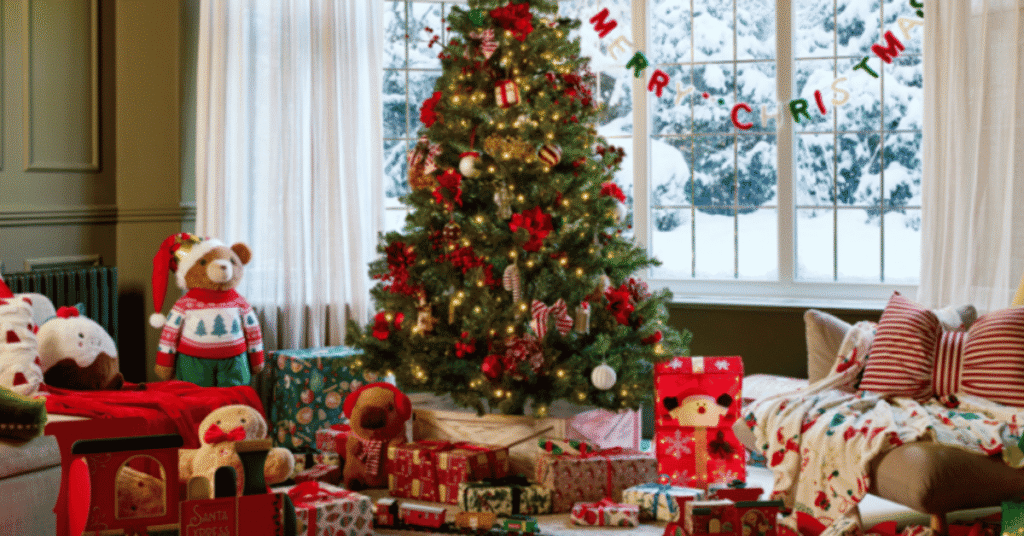
The result is that the gap between a good artificial tree and a real one, viewed from across a living room with the lights on, has narrowed to the point where most visitors genuinely cannot tell.
The Practical Case
Convenience is the reason most people give when you ask why they switched, and it is not a trivial one. A real tree means a trip to a lot, wrestling a net-wrapped tree into a car that was not designed for it, sawing a slice off the trunk, finding a stand that fits, and then keeping the thing watered for a month while it drops needles into every corner of the room.
An artificial tree means opening a box. For households with young children, limited mobility, or simply very little spare time in December, that difference matters more than any amount of romance about the smell of pine. In busy family homes, good kids toy storage can also help free up living room space before the tree and decorations come out.
There is an allergy argument as well. Real trees can carry mould spores and pollen, and for some people a month of living with one in a warm room is genuinely uncomfortable. An artificial tree sidesteps that entirely, provided it is stored somewhere dry and given a quick going-over with a soft brush or vacuum attachment before it goes up.
The Environmental Question, Honestly Answered
This is where the argument usually becomes heated, and where the facts are more nuanced than either side tends to admit.
A real tree grown in the UK has a genuinely good environmental story while it is growing. Plantations provide habitat, absorb carbon, and are replanted on rotation. The Woodland Trust’s guidance on choosing a greener Christmas tree makes the case for locally grown trees well, and if you buy one, how you dispose of it matters enormously. A tree that goes to landfill decomposes anaerobically and releases methane; one that is chipped or composted does not.
An artificial tree carries its environmental cost upfront, in manufacturing and shipping. The figure usually quoted is that you need to use one for somewhere between seven and twelve years before it works out better than buying a fresh tree annually. That sounds like a lot until you consider that a well-made tree stored properly will comfortably last fifteen or twenty.
The real environmental villain, in other words, is the cheap artificial tree that gets replaced after three seasons. Buy a good one, look after it, and keep it for two decades, and the sums look very different. Recycle Now has useful information on what to do with either type at the end of its life, which is worth a look before you make the decision.
Choosing Well
If you are switching, a few things separate a tree you will still love in year ten from one you will resent by year three.
Height first, and be realistic about it. Measure your ceiling and subtract at least 25cm for the topper and the stand. A tree that has to be bent at the top looks permanently apologetic.
Then look at the tip count, which manufacturers usually publish. More tips means a fuller tree, and it is the single most reliable indicator of how convincing it will look. A tree with mixed tips, combining the moulded realistic foliage on the outside with cheaper filler inside, gives you most of the visual benefit without the cost of an entirely moulded tree.
Decide about lights before you buy. Pre-lit trees save an enormous amount of time and tangle, but you are committed to that colour temperature for the life of the tree. Unlit trees give you freedom and mean a single failed bulb string does not compromise the whole thing. Browsing a proper range of artificial Christmas trees in different heights and finishes is the easiest way to get a feel for how much difference tip count and branch construction actually make in person.
Looking After It
The reason artificial trees get a bad name is almost always storage. A tree that spends eleven months compressed in a damp garage under a stack of boxes will not look good in year five.
Keep the original box if you possibly can, or invest in a proper storage bag with a bit of structure to it. If storage is already tight, making better use of under-stairs storage can give Christmas decorations and seasonal items a proper place for the rest of the year. Store it somewhere dry and off the floor. Before packing it away, give it a quick clean, because dust that sits on branches for a year becomes much harder to remove.
When you put it up, spend ten minutes fluffing the branches properly, working from the trunk outwards and bending the tips in slightly different directions. This is the step everyone skips, and it is the difference between a tree that looks obviously artificial and one that does not.
What About the Smell?
This is the one genuine thing an artificial tree cannot give you, and it is worth being honest about it rather than pretending otherwise. The resinous, slightly citrus smell of a fresh fir is a real part of Christmas for a lot of people, and no amount of clever moulding replicates it.
The usual workaround is a small bundle of real foliage somewhere else in the room, on a mantelpiece or a bannister, which gives you the scent without the needle drop. Scented pine cones in a bowl near the tree work reasonably well, and genuine fir essential oil in a diffuser works better than most of the heavily sweetened Christmas scents on the market, which tend to smell of cinnamon and sugar rather than of a forest.
It is a compromise, and some households decide it is the deciding factor. That is a perfectly reasonable place to land.
A Tradition That Bends
There is a slightly sentimental argument worth making at the end of all this. The households that have switched do not seem to have lost anything. The tree still goes up on the same weekend. The same box of baubles still comes down from the loft, with the ones the children made at primary school still in it. The same arguments about where the fairy goes still happen.
What has changed is the admin, not the tradition. And for a great many families, that turns out to be the part they were happy to let go.