Saturday morning five-a-side. Sunday league rugby. After-school hockey clubs that have quietly grown busier every year. Grassroots sport has been on the rise across the country, and with more people playing more often, an Emergency Dentist in Leamington Spa is now seeing something that tracks directly with it: a steady rise in dental trauma cases that have nothing to do with decay or gum disease and everything to do with a stray elbow, a ball, or a fall.
Why This Isn’t Just Anecdotal
Dental researchers have long classified certain sports by trauma risk, and the list reads like a roll call of the UK’s most popular grassroots activities. Rugby, hockey, basketball, and football all sit in the moderate-to-high risk category for dentofacial injury, according to international sports dentistry classifications, not because they’re unusually dangerous sports, but because they involve enough incidental contact, at enough speed, for a knock to the mouth to happen without any real warning.
As participation in these sports has grown at grassroots level more adult five-a-side leagues, more junior club sport, more people returning to team sport after time away the exposure to that risk has grown with it, even though no single sport has become more dangerous than it used to be.
The Injuries That Show Up Most
A chipped or fractured front tooth is the most common presentation, usually from a direct blow rather than a fall. Luxation, where a tooth is knocked out of its normal position without being fully displaced, is close behind, and it’s often more serious than it looks, because the tooth can appear intact while the supporting ligament underneath has been damaged. Full avulsion, where a tooth is knocked out completely, is less common but is the one genuine race-against-time emergency in dentistry, a tooth has the best chance of being saved if it’s replanted within a short window, ideally kept moist rather than left to dry out.
The Gap That Makes This Worse Than It Needs to Be
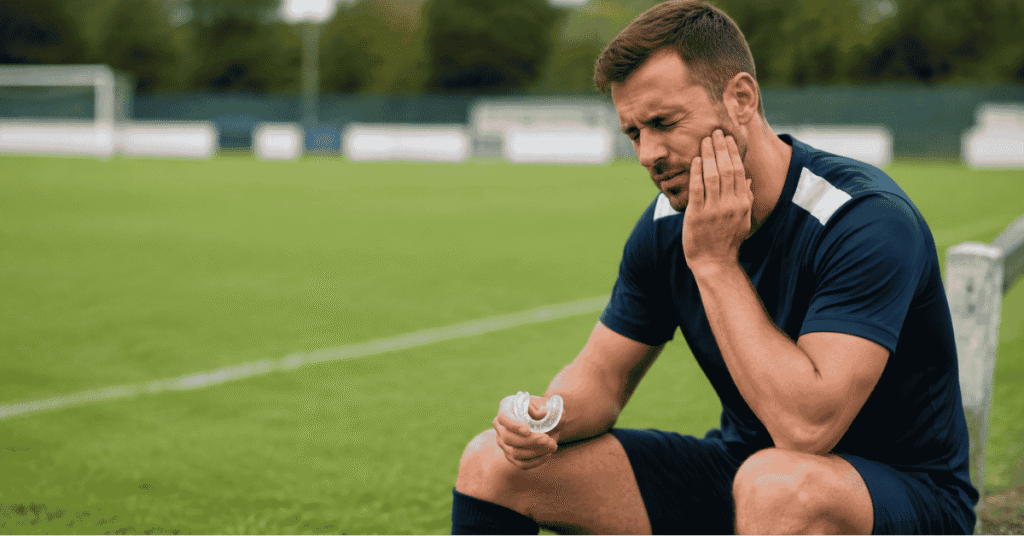
Here’s the part that should change more than it has. Studies on mouthguard use consistently find that even where players know mouthguards exist and understand they reduce injury risk, actual usage rates during practice and casual play remain low under a quarter of participants in grassroots and amateur settings, compared with much higher awareness rates. The gap isn’t a knowledge problem. It’s a habit problem, and it shows up specifically in exactly the kind of low-stakes, no-referee grassroots games where mouthguards are treated as optional gear rather than standard kit.
What Actually Helps in the Moment
If a tooth is knocked out completely, the single most useful thing anyone on the sideline can do is avoid touching the root, rinse it gently only if it’s visibly dirty, and try to reinsert it into the socket if possible or if not, keep it in milk rather than water while getting to a dentist as quickly as possible. Time matters more than almost anything else here; a tooth handled and replanted quickly has a meaningfully better chance of survival than one left dry for even twenty or thirty minutes.
For a chipped tooth or one that feels loose but is still in place, the priority is simply getting seen promptly rather than waiting to see if it settles on its own, a loose tooth can still be salvageable with the right early treatment, but that window closes as time passes.
Where This Comes Up in Practice
Andrew Lee Dental Practice sees this pattern often enough that it’s become a recognisable category of emergency call rather than a rare occurrence, a parent ringing about a child’s fractured incisor after a hockey match, or an adult player calling mid-weekend after a five-a-side collision. The practice’s emergency provision, including evening and weekend appointment availability, exists in large part because dental trauma doesn’t wait for a Monday morning booking slot, and delaying treatment on an injury like this tends to make the outcome worse rather than giving it time to resolve.
A Simple Change With an Outsized Effect
None of this requires a change in how any of these sports are played. Custom-fitted mouthguards, made specifically for a person’s teeth rather than the boil-and-bite versions sold in sports shops, offer meaningfully better protection and are far more likely to actually get worn because they’re comfortable enough to keep in during play. For anyone in a grassroots league, adult or junior asking a dentist about a properly fitted mouthguard is a five-minute conversation that meaningfully lowers the odds of ever needing an emergency appointment in the first place.
Final Thoughts
Grassroots sport growing is a genuinely good thing, and none of this is an argument against playing. But the research is consistent: certain popular sports carry a real, well-documented trauma risk, and mouthguard use remains far lower than it should be given how well understood that risk is. If you or your child play regularly, it’s worth treating a mouthguard as standard kit rather than an optional extra and worth knowing, before you ever need it, that an Emergency dentist leamington spa can act fastest on a knocked-out tooth when you call within minutes rather than hours.