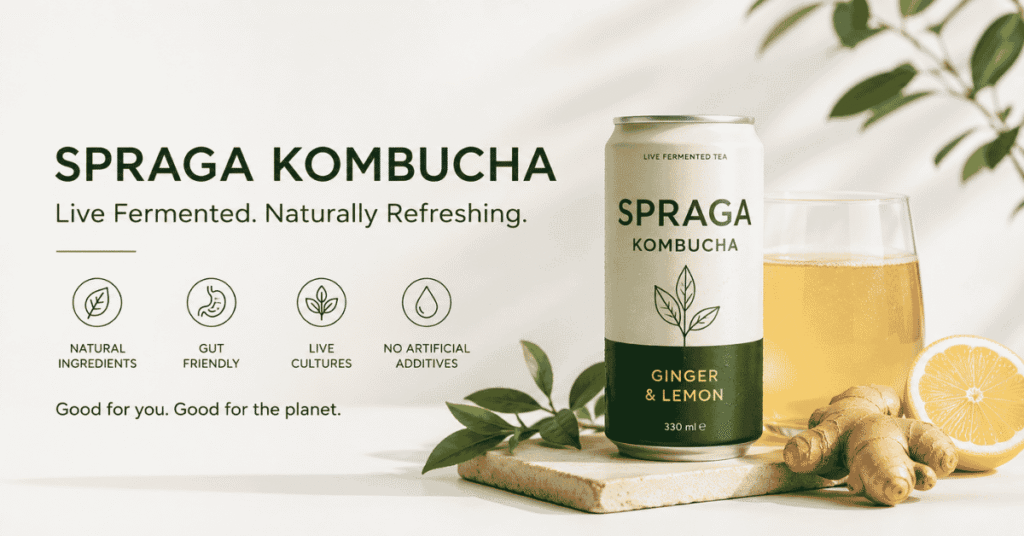
The European soft drinks market is changing faster than it may seem. Traditional sugary fizzy drinks are losing profitability, while consumers are increasingly turning away from packaged juices and artificially flavoured lemonades. According to Nykyta Izmaylov, investor and founder of the SPRAGA kombucha brand, EU consumers are consciously shifting towards biofermented products.
Natural kombucha is playing a key role in this shift, with SPRAGA seeking to establish a new technological benchmark in the category. Yet fermented tea is still surrounded by numerous stereotypes. We examine the main myths and the real economics behind this growing market.
1. It Is Just the Same Old Homemade ‘Tea Mushroom’, Only in a Fancy Can
Not when it comes to industrial production.
Home fermentation in a three-litre jar is an unpredictable process that produces an inconsistent flavour. SPRAGA kombucha, for example, is produced by fermenting tea leaves using a standardised symbiotic culture of bacteria and yeast, known as SCOBY.
The result is a naturally carbonated drink produced without artificial carbonation or preservatives.
2. If Kombucha Is Industrially Produced, It Must Be Full of Preservatives
The basic ingredients of high-quality kombucha are remarkably simple: water, tea and sugar.
The sugar is not added simply for sweetness; it serves as a source of nutrition for the microorganisms involved in fermentation. Additional flavours, ranging from ginger to natural cold-pressed juices, are introduced during the blending stage.
There are no synthetic colourings or artificial sweeteners.
3. Kombucha Is Not Suitable for Drivers or Athletes
Kombucha is a non-alcoholic product containing up to 0.5% alcohol, in accordance with strict EU standards. Natural fermentation leaves only trace amounts of alcohol.
It is suitable for drivers and for people who choose to maintain an alcohol-free lifestyle.
4. All the Beneficial Bacteria Die at the Factory
It depends entirely on the producer’s business model.
Many mass-market brands in Europe choose pasteurisation — heat treatment — so that their products can remain on ordinary shelves at room temperature for extended periods. However, this process kills the live probiotic cultures.
The position taken by Nykyta Izmaylov and SPRAGA is clear: no pasteurisation.
Instead, microfiltration and a strictly controlled cold supply chain — from the production facility all the way to the retail shelf — are used to preserve the live nature of the product.
5. Kombucha Contains Too Much Sugar
Sugar is indeed added at the beginning of the production process, but during fermentation the microorganisms consume much of it, producing organic acids and other fermentation compounds.
The result is a low-calorie functional drink with a comparatively low residual sugar content. Kombucha is increasingly associated with the wider consumer trend towards fermented foods, gut health and microbiome-conscious nutrition.
6. Kombucha Is Just Another Marketing Invention
Fermented tea has a history stretching back thousands of years in Asia, but it is now experiencing one of its fastest periods of growth in Europe.
Kombucha has become a natural part of the broader trend towards mindful drinking and alcohol alternatives. In European bars and restaurants, it is increasingly served in wine glasses as a sophisticated non-alcoholic aperitif rather than simply as another soft drink.
Nykyta Izmaylov believes that the era of artificially flavoured fizzy drinks in Europe is quietly drawing to a close.
The companies most likely to succeed, he argues, will be those capable of combining a live fermented product, consistent flavour and a highly reliable cold-chain logistics infrastructure.
The experience of the SPRAGA brand demonstrates how technological precision combined with a clean and transparent ingredient list can transform fermented tea from a niche trend into a serious contender for leadership in the European functional drinks market.