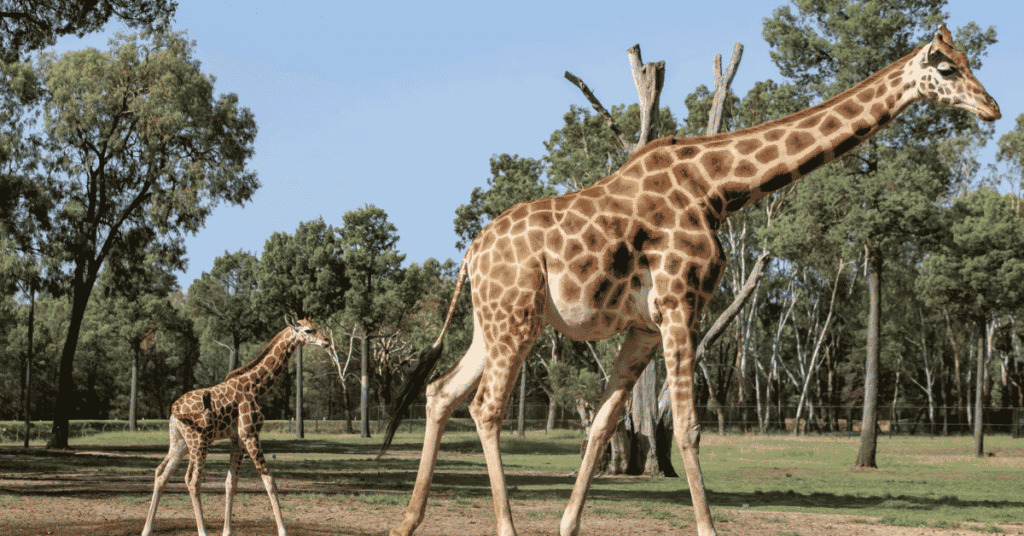
You can look at a hundred photos of a giraffe and still not be ready for the real thing. There’s something about standing at the fence of a UK zoo or wildlife park, tilting your head back further than feels natural, that photos just don’t capture. But honestly, the height is the easy part to notice. The more interesting stuff is what’s going on underneath how a giraffe eats, how it gets on with other giraffes, and that strange, dark giraffe tongue that seems to do half the work.
So, How Big Is a Giraffe Really?
There’s no competition here — a giraffe is the tallest land animal on Earth, full stop. Adult males generally run 5.5 to 6 metres tall, and females are usually a bit under that. Big males can weigh well over 1,000kg. Try picturing a small car with legs.
Even as babies they’re huge. A newborn calf is typically 1.7 to 1.9 metres tall at birth, and it’s on its feet within hours of arriving. That’s not really optional in the wild a calf that takes too long to stand is a calf that doesn’t make it.
Here’s the fact that trips people up nearly every time: a giraffe’s neck has seven vertebrae. Exactly the same number as yours or mine. They’re just stretched out to a ridiculous length.
Where Do Giraffes Live?
Giraffes are native to sub-Saharan Africa, spread across savannahs, open woodland, and grassland with scattered trees. Some populations deal with fairly dry, sparse terrain; others live somewhere greener and more wooded. What ties it together is browse leafy vegetation, ideally up high, out of reach of most competitors.
That height isn’t just for looking impressive at the zoo. It means a giraffe can feed where almost nothing else can reach, and it gives them a genuine advantage spotting danger across open country long before it gets close.
What Does a Giraffe Actually Eat?
Giraffes are browsers, not grazers, so leaves, young shoots, flowers and seed pods make up most of the diet. Acacia trees carry a lot of the weight here across much of their range.
Reaching the food is one thing. Handling it is another. Tough lips grip rough, woody branches, and the giraffe tongue does the fine work sliding between twigs, wrapping around leaves, pulling them free without wasting effort on the branch itself.
Leaves also provide a decent chunk of water. When browse is good, a giraffe can go a while without drinking, which is honestly for the best, because drinking is an awkward, vulnerable business for them — front legs splayed wide, neck lowered all the way to the ground.
The Giraffe Tongue: Length, Colour and Why It Works So Well
If any single feature sums up a giraffe, it’s the tongue. It runs somewhere around 45 to 50 centimetres long enough to function almost like a second limb while feeding.
Colour-wise, it throws people off. Expect pink, get deep blue-black or purple instead. The most common explanation is sun protection — that heavy pigmentation shields the tongue during the long hours it spends exposed to direct sunlight each day.
But length and colour aside, what actually matters is control. The giraffe tongue can curl around a cluster of leaves with real precision and strip them clean, rather than the animal just biting through whatever’s in front of it.
How the Giraffe Tongue Handles Thorns
Acacia branches are not friendly. They’re covered in long, sharp thorns, and yet giraffes browse among them like it’s nothing.
The giraffe tongue slips between the thorns with a kind of practiced accuracy, curling around leaves while steering clear of the sharpest points. Tough tissue lining the mouth helps too, along with thick saliva that moves coarse plant material along more easily.
Watch one feed for a minute or two and any idea that giraffes are clumsy just falls apart. It’s slow, careful, almost surgical work.
How Long Do Giraffes Live?
In the wild, a giraffe typically lives somewhere between 20 and 25 years though that number moves around a lot depending on drought, food supply, disease, injury and predation.
Calves carry the most risk by far. Lions and hyenas go after young animals far more often than fully grown adults, and there’s a good reason for that: a healthy adult giraffe can deliver a kick strong enough to seriously injure or even kill a predator.
In zoos, with steady food and veterinary care on hand, giraffes often live longer than they would in the wild.
Social Life: Loose Groups, Not Fixed Herds
Giraffe social structure is looser than most people assume. Rather than one herd for life, individuals drift in and out of groups over time.
Females tend to stick close to their calves. Adult males are more likely to wander alone or form small, temporary groups with other males. When males do compete, it’s through “necking” — a slow, deliberate contest where they swing their heads and necks into each other to establish who’s dominant.
They come across as quiet animals, but there’s more going on than the calm exterior suggests posture, scent, and low-frequency sound all play a part in how they communicate.
A Body Built for Extreme Height
Being this tall creates problems no other mammal really has to deal with. Getting blood all the way up to the brain takes serious cardiovascular power, and a giraffe’s heart and vessels are built specifically to manage that pressure.
The legs deserve more credit than they usually get, too. They look thin from a distance, but they’re carrying enormous weight and can still produce real bursts of speed when needed.
Even the coat does more than look good. Every giraffe has its own unique patch pattern — as individual as a fingerprint — and the overall look shifts noticeably from one population to the next.
Why the Giraffe Tongue Matters for Survival
It’s tempting to file the giraffe tongue away as a fun fact for the zoo gift shop, but it’s really a survival tool. Its length and flexibility open up a food source high, thorny, awkward-to-reach leaves that most other animals simply can’t compete for.
That matters most during dry spells, when lower vegetation runs thin and competition for food gets tighter. Height, neck, lips and tongue aren’t separate features doing their own thing they work as one system.
Conservation: A Familiar Face Under Quiet Pressure
It’s easy to assume an animal this recognisable must be doing fine, but several giraffe populations are under real pressure. Habitat loss, fragmented landscapes, illegal hunting and conflict with people are all chipping away at numbers in parts of their range.
Conservation work focuses on protecting habitat, tracking population numbers, and working alongside communities who share the land with giraffes. Keeping migration routes open matters a great deal, since these animals need space to move between feeding and breeding grounds.
For a lot of people in the UK, a responsible zoo visit is the first proper introduction to any of this. The height is what grabs your attention first but a giraffe’s long-term future really comes down to the health of African ecosystems, not how impressive it looks from the viewing platform.
FAQs
How long is a giraffe tongue?
Somewhere around 45 to 50 centimetres long enough to give real reach and control while feeding among branches.
How long do giraffes live?
Roughly 20 to 25 years in the wild, though health, food supply and predation risk all shift that number around.