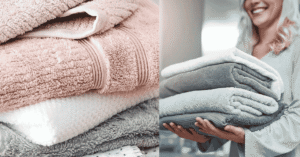
If your bath towels feel like sandpaper every time you dry yourself, you are not the only one. Over time, almost all towels go hard, stiff, and scratchy.
Most people think the answer is adding more fabric conditioner to the wash. But that actually makes the problem worse.
Crusty towels are not ready for the bin. They just have a heavy buildup of old washing detergent, fabric softener, and hard water limescale. You can strip all of that out using two cheap items from your kitchen cupboard.
Why Towels Go Hard in the First Place
Cotton towels are made of thousands of tiny loops that soak up water. When those loops get clogged or squashed flat, the towel goes stiff.
Here are the three main reasons it happens:
1. Fabric Conditioner Coats the Fibres
Fabric softener works by putting a thin waxy layer over fabric. On clothes it feels nice, but on towels it coats the cotton loops and stops them from soaking up water. That waxy layer builds up with every wash and turns crusty.
2. Hard Water in the Pipes
Most parts of the UK have hard water, especially in London and the South East. Hard water carries calcium and chalk. When you wash at high heat, those minerals stick to the cotton, drying hard like the limescale inside a kettle.
3. Using Too Much Detergent
Laundry pods and liquids are very concentrated. If you put too much soap in, the machine cannot rinse it all away. That leftover soap dries inside the towel and makes it feel scratchy.
How to Reset Your Towels (Step by Step)
To get your towels soft again, you need white distilled vinegar and ordinary bicarbonate of soda.
Do not mix them in the same wash. Vinegar is an acid and bicarb is an alkali. If you put them in together, they cancel each other out. Run them as two separate, back-to-back hot washes.
| Wash Step | What to Add | Wash Setting | What It Does |
|---|---|---|---|
| Wash 1 | 250ml White Distilled Vinegar | 60°C Hot Wash | Strips away old fabric softener and melts limescale |
| Wash 2 | 100g Bicarbonate of Soda | 60°C Hot Wash | Cleans out lingering oils and fluffs up the cotton loops |
Wash 1: The Vinegar Wash
- Put your stiff towels in the washing machine. Only fill the drum about half full so the towels have plenty of room to move.
- Do not add any washing powder, liquid, or fabric conditioner.
- Pour 250ml of white distilled vinegar into the detergent drawer or straight into the drum.
- Run a hot cycle at 60°C.
- The vinegar cuts through old fabric softener and melts away hard water limescale.
Wash 2: The Bicarbonate of Soda Wash
- Leave the wet towels in the drum when the first cycle finishes.
- Still do not add any washing powder or liquid.
- Sprinkle 100g of bicarbonate of soda over the wet towels.
- Run another hot cycle at 60°C.
- The bicarb cleans away any lingering oils, takes away damp smells, and opens up the cotton loops so they feel soft again.
How to Dry Towels So They Stay Soft
How you dry towels makes a big difference to how they feel.
Give Them a Hard Shake
Before you hang a towel up, take it by the corners and give it two or three sharp shakes in the air. That pops the flattened cotton loops open before they dry.
The Line-Then-Tumble Trick
If you want soft towels without running the tumble dryer for an hour, try this:
Hang your towels on an airer or washing line until they are about 90% dry. Then put them in the tumble dryer on low heat for just 10 minutes. That short spin fluffs the fibres up without running up your electric bill.
If you dry towels indoors on an airer during cold months, remember to open a window. Wet towels put a lot of moisture into the air. If you get moisture on your glass in the morning, have a look at our guide on how to stop condensation on bedroom windows overnight.
Simple Habits to Stop Towels Going Stiff Again
Once your towels are soft, a few small changes will keep them that way:
- Drop fabric conditioner completely: Towels do not need it. Without it, they soak up water much faster and dry quicker on the rail. Hanging your towels spread out on a heated rail also helps air circulate between uses; see our guide on choosing a matte black towel rail radiator for your bathroom.
- Use half the detergent: Use half the normal amount of washing liquid or powder. Less soap means clean rinsing and no leftover scum.
- Do not stuff the machine full: Towels get very heavy when wet. If the drum is packed tight, the water cannot rinse through the fibres.
- Wash towels on their own: Keep towels away from jeans, hoodies, and clothes with zips. Rough clothes rub against the cotton and damage the loops.
Frequently Asked Questions
Can I use brown malt vinegar instead?
No. Brown malt vinegar contains barley grain extracts that can stain pale towels and leave a chip-shop smell. Always use clear, distilled white vinegar. It leaves no smell once dry.
Can I use soda crystals instead?
Yes. Soda crystals are stronger than bicarbonate of soda and work well in hard water areas. Put two tablespoons into the drum during the second wash cycle.
Why do my clean towels smell damp after one use?
Old fabric softener seals water and bacteria deep inside the cotton. As soon as you dry yourself with it, moisture reactivates that trapped bacteria. The two-step reset wash strips that layer and stops the smell.
How often should I do this reset wash?
Every four to six weeks is plenty. In between, just wash your towels as normal using half your usual detergent and no fabric conditioner.