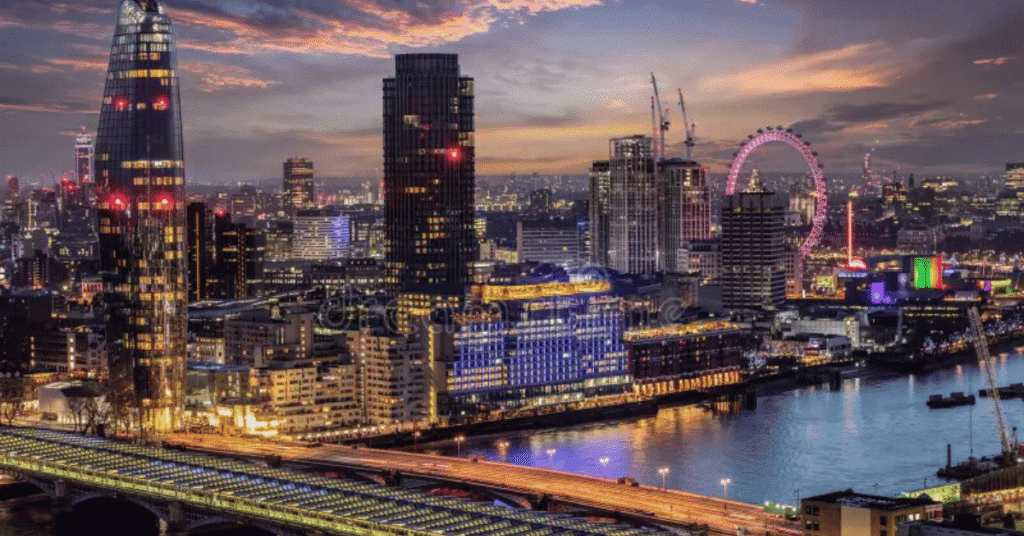
Trying to photograph the London Skyline sounds simple until you get there and realise the city keeps changing shape depending on where you stand. From one angle, London looks historic and heavy, full of domes and stone. From another, it feels sharp, glassy, and almost futuristic. That is part of the appeal. You are not chasing one perfect view. You are choosing the version of London you want to keep.
If the goal is a strong photo rather than just ticking off a viewpoint, a few places stand out. Some are obvious for a reason. Others work better because they give the skyline room to breathe.
London Skyline from Waterloo Bridge
Waterloo Bridge is one of the easiest places to get a satisfying London Skyline photo without much planning. You are high enough above the Thames to see the city open up, and the river naturally pulls the eye through the frame. Even a basic phone camera tends to do well here because the composition is already working in your favour.
From the bridge, you can catch several layers of London at once. The South Bank sits close, the London Eye pulls attention, and further out you get the mix of older landmarks and newer towers that makes the skyline feel distinctly London rather than interchangeable with any other city.
The best results usually come later in the day, especially when the light starts warming up and the buildings stop looking flat. If the weather has just cleared after rain, even better. London often photographs best when the air feels freshly washed rather than bright and harsh.
London Skyline from Primrose Hill
Primrose Hill gives you distance, and distance helps. Some London viewpoints throw too much at you at once. Primrose Hill does the opposite. It lets the skyline sit on the horizon in a way that feels calmer and more complete.
This is not the place for an aggressive close-up city shot. It works best when you lean into atmosphere. A bit of foreground, some sky, and the skyline stretched in the distance usually looks better than trying to force everything into one tight frame. On a clear evening, the buildings pick up enough light to stand out without losing the softness that makes this spot appealing.
Locals like Primrose Hill because it feels less mechanical than the rooftop viewing platforms. There is less pressure to grab a quick photo and move on. You can stand there, look around, wait for the light to shift, and get something that feels less like a standard tourist image.
London Skyline from Greenwich Park
If you want the London Skyline to feel dramatic, Greenwich Park is one of the strongest choices. The view has depth, structure, and a proper sense of scale. You get the slope of the park in front, the city beyond, and enough space between the two for the skyline to look deliberate rather than crowded.
This is also one of the best places to show London’s eastern side properly. Canary Wharf often looks especially strong from here, and the broader city line behind it gives the image shape. On a clear day, it is one of those views that makes London look bigger than people expect.
A common mistake here is going too wide too quickly. The full view is impressive in person, but a slightly tighter frame often gives a better photo. It brings the skyline forward and stops the foreground from swallowing the scene.
London Skyline from Sky Garden
Sky Garden gives you a more polished version of the London Skyline. It is not rough, open-air London. It is sleek London. The high glass viewpoint, the indoor planting, and the way the city spreads out below all combine to create a cleaner, more modern feel.
That contrast is what makes it work. You are looking at steel, offices, bridges, and river curves, but the space itself softens the image. It helps if you want a skyline shot that feels a bit more refined than what you get from a park or bridge.
Photos here tend to look best when you avoid trying to capture everything. Pick a direction. Find a clear section of skyline. Use the windows and height to simplify the scene instead of treating it like a giant panorama challenge.
London Skyline from The Shard
The Shard is the big one. If you want height, spectacle, and the feeling that London is spread out under your feet, this is the obvious place. The skyline from up there feels massive. Roads become lines, the Thames becomes a silver curve, and familiar landmarks suddenly look small enough to fit into a single glance.
That said, height alone does not automatically produce the best photo. At this level, images can become too distant if you are not careful. The stronger shots usually come from using shapes in the city below to anchor the frame. The river helps. So do bridges, building clusters, and the contrast between older parts of London and newer glass towers.
Evening is usually the best time for photos here because the city begins to glow without turning into a black mass. That short period between daylight and full darkness is when the skyline looks most alive.
London Skyline photo tips that matter
A good London Skyline photo usually has more to do with timing than expensive equipment. Clear conditions help, but perfect blue skies are not always the winner. A little texture in the clouds can make the city look far better. Flat white sky, on the other hand, often kills the image.
Do not fall into the trap of taking the same wide shot at every location. London looks better when you vary the approach. One viewpoint might suit a broad skyline image. Another might work better with a tighter crop focused on a few standout buildings. The city rewards selection, not just coverage.
It also helps to wait. London light changes fast. A crowded spot clears. A dull scene sharpens. A skyline that looked average two minutes ago suddenly starts working. Most weak photos happen because people rush the obvious frame and move on.
FAQs
What time is best for a London Skyline photo?
Late afternoon into blue hour usually gives the strongest results. After rain can be especially good.
Which free London Skyline spot is best?
Greenwich Park and Waterloo Bridge are both strong. Greenwich feels more dramatic. Waterloo feels more central and classic.