Concrete blocks look simple enough until it is time to order them. Then you are faced with dense blocks, lightweight blocks, aerated blocks, different strengths and several thicknesses that appear almost identical in a product photo.
The correct choice depends on the wall, not just the price. A block used for an internal partition does not need to perform like one supporting a roof or holding back soil. Getting that distinction right at the beginning can save wasted materials, extra labour and a second delivery charge.
How Much Do Concrete Blocks Cost in the UK?
There is no single UK price for concrete blocks. The cost changes with the block type, thickness, strength rating, order quantity and delivery distance.
Dense blocks are usually one of the more economical choices. Lightweight and aerated products often cost more per unit, although they can be quicker to carry, cut and lay. Specialist blocks made for higher loads, better insulation or improved sound control may cost more again.
Delivery is where smaller jobs can become expensive. Imagine ordering enough blocks for a short garden wall. The material cost may look reasonable, but haulage, pallet charges and mechanical offloading can add a noticeable amount to the bill. A second order for only a few missing blocks can be even less cost-effective.
Before placing an order, check:
- Whether VAT is included
- How many blocks come on a pallet
- Whether delivery includes offloading
- Whether empty pallets must be returned
- Whether the vehicle can reach the property
A narrow street, low bridge, parked cars or restricted driveway can affect where the blocks are left. Confirming access beforehand is easier than moving a full pallet by hand after it has been dropped in the wrong place.
Main Types of Concrete Blocks
Concrete blocks are not all made in the same way. Their density affects weight, strength, insulation and ease of installation.
Dense Concrete Blocks
Dense blocks are solid, heavy and durable. They are commonly used for foundations, garages, workshops and walls that need to withstand knocks or heavier loads.
Their mass also helps reduce sound transfer. This can make them useful for separating walls or utility spaces where noise control matters.
The trade-off is handling. Carrying dense blocks through an existing house or up scaffolding is hard work. Cutting them also takes more effort than cutting aerated products. For external walls, they normally need additional insulation because their thermal performance is limited compared with lighter alternatives.
Lightweight Concrete Blocks
Lightweight blocks use lower-density aggregates. They are easier to lift and can help speed up work on extensions, upper floors and internal partitions.
This becomes important on awkward sites. On a rear extension with no side access, every block may need to pass through the house. A lighter product can reduce handling time and physical strain.
That does not mean every lightweight block can be used structurally. Its compressive strength must still match the drawings and the load it will carry.
Aerated Concrete Blocks
Aerated blocks contain many small air pockets. This reduces their weight and improves their thermal performance.
They are popular in residential construction because they can be cut neatly around doors, windows, pipework and cables. Chasing for electrical work is also easier than with dense blocks.
The main detail people overlook is fixing strength. Heavy radiators, kitchen units and shelving require fixings designed for aerated material. Standard plugs may pull loose if the load is high.
Hollow Concrete Blocks: Where They Make Sense
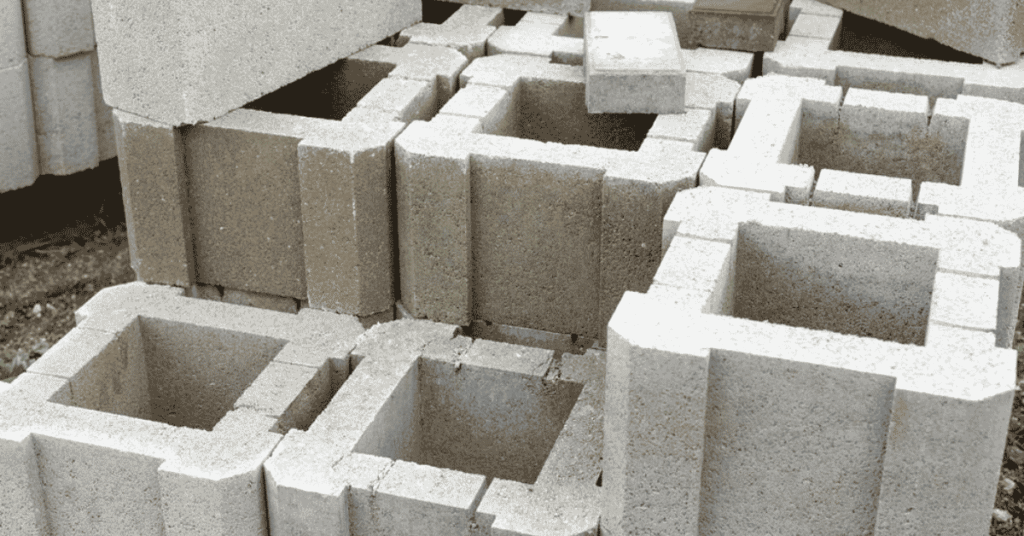
Hollow concrete blocks contain open cavities rather than being completely solid. These cavities reduce weight and can provide space for reinforcement or concrete filling.
They may be used in boundary walls, agricultural buildings, reinforced wall systems and some retaining structures. Their suitability depends on the design rather than appearance alone.
For example, a retaining wall must resist pressure from the soil behind it. If rainwater collects in that soil, the pressure increases. Strong hollow concrete blocks will not solve poor drainage, weak foundations or missing reinforcement.
Wall height, wind exposure, ground conditions and the intended finish all need consideration. For structural work, use the specified product rather than swapping it for something that looks similar.
Standard Concrete Block Size in the UK
A common concrete block size in the UK is approximately 440 mm long by 215 mm high. The thickness varies according to the wall.
Common thicknesses include:
- 75 mm
- 100 mm
- 140 mm
- 190 mm
A 100 mm block is widely used for internal partitions and cavity-wall construction. Thicker blocks may be needed where the wall carries heavier loads or requires better stability and sound reduction.
The stated concrete block size usually refers to the block itself. Mortar joints must also be included when working out the finished wall dimensions.
Two blocks can have the same face size but still differ in density, thickness and strength. Check the full specification before ordering, especially when matching an existing wall.
Choosing the Correct Concrete Block Size
Start with the job the wall must do.
An internal partition may only need to divide rooms and support light fittings. A load-bearing wall may carry floors, roof timbers or steelwork. A garden retaining wall has to resist pressure from soil and water.
Space also matters. A thicker block creates a wider wall and can reduce usable floor area in a small extension. A thinner block saves space but may not provide the strength, fire resistance or sound performance required.
Where an architect or structural engineer has specified a block, do not substitute it based on price alone. Two products may look interchangeable while performing very differently.
Best Uses for Concrete Blocks
Dense concrete blocks work well in garages, foundations, workshops and hard-wearing walls. They are dependable where strength and impact resistance are the main priorities.
Lightweight and aerated blocks are often more practical for home extensions, upper floors and internal walls. They are easier to handle and, in the case of aerated blocks, offer better thermal performance.
For garden walls, concrete blocks provide a useful base for render, masonry paint or cladding. The foundation remains critical. Many cracked walls fail because the ground was poorly prepared, not because the blocks were faulty.
Tall boundary walls and retaining walls require more careful planning. Wind load, drainage and reinforcement can matter as much as the blocks themselves.
Ordering Without Wasting Money
Measure the wall carefully, subtract doors and windows, then allow a modest amount for cuts and breakages.
Do not order too tightly. Running short by ten blocks can trigger another delivery fee. Ordering far too many creates storage and disposal problems.
Compare the full job cost rather than the unit price. A lighter block may be more expensive to buy but quicker to install. A cheap dense block may increase labour if access is difficult.
FAQs
Are hollow concrete blocks suitable for garden walls?
They can be, but the foundation, wall height, exposure and reinforcement must suit the design.
What is the usual concrete block size in the UK?
A common face size is around 440 mm by 215 mm. Thickness varies according to the wall’s purpose and required strength.